The 2015 Victorian Chess Championships have been run & won, with International Master James Morris prevailing, scoring an impressive 8.5/11, going through the tournament undefeated. Second place was shared between GM Darryl Johansen & FM Chris Wallis on 8/11, with Darryl also going through the event undefeated, while Chris managed to win the most games of any player throughout the tournament.
I was once again arbiter for the event & the event was once again played with a friendly atmosphere, with very few hassles. The main issue with the tournament at present has to do with the 'maximum one postponement per player' rule & how this is to be managed/enforced. As the arbiter for the event, I was fairly liberal with this 'rule' & the players for the most part did not seem too bothered by it. However the related issue for the tournament has to do with the format & venue(s) used. At present, the tournament is played as a 12-player round robin, with the tournament being run over a two month period, with the playing days/venues shared amongst the three largest chess clubs, Melbourne, Box Hill & Noble Park. This means that players effectively need three potentials days of the week free to play in the event, as well as being able to travel to a number of parts of Melbourne. This is a discouragement for some players & means that the tournament is not as strong as it potentially could be.
In terms of alternatives, the previous incarnation of the Victorian Championships, largely supervised by Gary Wastell, saw players nominate suitable times & venues from around 18 possible options & a playing schedule was drawn up that suited all players. This solved some problems, but often meant that you did not know where you were in the event, as players were on differing schedules, with many players being multiple games ahead or behind other players.
Interstate, the options seem to take on one of two standard formats - either weekly at a standard venue (as is done in NSW & SA), or sometimes over a week (Qld) or a weekend (Tas). The obvious differences between both are the length of time required for the weekly format, while the week/weekend format does not allow for the depth of preparation for games that the weekly format allows.
Personally I think whatever attracts the strongest field would be the best, but what that is in the Victorian context is something that I don't know.
Although he only placed second, as arbiter I felt that some of the most entertaining & interesting games were played by Chris Wallis - here is a sample of two of his wins from the event.
Showing posts with label Box Hill Chess Club. Show all posts
Showing posts with label Box Hill Chess Club. Show all posts
Tuesday, 30 June 2015

Monday, 30 December 2013
Australasian Masters - the conclusion
The Australasian Masters came to an interesting conclusion just before Christmas. From the outset, Latvian GM Normunds Miezis had been a runaway leader, but all that changed in the final rounds of the Australasian Masters! After starting with 5/5, his progress was slowed by draws against GM Vasily Papin & FM Anton Smirnov, but few would have expected the finish to the event, with Miezis losing to both IM Bobby Cheng & IM Max Illingworth in the final two rounds to finish on 6/9. However, such was his lead that this was enough to win the tournament, albeit in equal first, shared with Russian GM Vasily Papin who went through the event undefeated. Vietnamese GM Tu Hoang Thong finished in outright third on 5.5/9 to ensure that all the prize money went to the visiting Grandmasters. As far as the Australians were concerned, the best results were from IMs Bobby Cheng & Max Illingworth, who finished on 5/9 in a tie for fourth place, while FM Anton Smirnov impressed with his solid play, but a final round loss to Bobby Cheng saw him miss out on his final IM norm by just half a point.
The IM norm event on the other hand saw to players leading the field throughout the tournament - FM Chris Wallis & Karl Zelesco were the leaders throughout the event, sometimes tied, other times in first & second place, but they finally both finished on 7/9 to share the prize money (Karl won the trophy on countback). The 7/9 score was the minimum required for an IM norm & Karl Zelesco earnt his first IM norm as a result of his performance in this event. Chris Wallis was slightly less fortunate, with his high rating (and subsequent lower rating of his opponents) counting against him, so that it was not possible for him to get a norm, regardless of his final score. However it was an impressive tournament from Chris, who was the only player to go through the event undefeated. FM Bob Smith finished outright third on 6/9, while IMs Vladimir Smirnov & Andrew Brown were equal fourth on 5.5/9.
Overall the tournament was a breeze to run, with all players being very friendly & co-operative, with no major issues.
Hopefully this can be the beginning of something more regular in Australian chess, rather than simply a one-off special for the 25th event - Australia now has a significant number of International Masters, but still very few progress beyond this level to become Grandmasters & tournaments like this provide fantastic opportunities for aspiring GMs to test their skills against the very best.
Full details of the tournament can be found in the 2013 Archive on the Box Hill Chess Club website, including Cross Tables, Bulletins & PGN files of games
Leonid Sandler also managed to do a few more videos with some of the participants & I have included them below:
Visiting Latvian GM & tournament winner Normunds Miezis:
GM Darryl Johansen:
IM James Morris:
A few photos from the tournament & prize giving:
 IM Bobby Cheng defeats GM Normunds Miezis in round 8

 GM Event =1st place - GM Vasily Papin


 Post-tournament dinner with players, friends & families.
Interesting games
IM Event
Zelesco-Stojic from round 8
Rujevic-Ootes from round 9
GM Event
Miezis-Cheng from round 8
Illingworth-Miezis from round 9
Hopefully this will be the first of many such GM-events in Melbourne (or even Australia more generally) rather than just a one-off event!
The IM norm event on the other hand saw to players leading the field throughout the tournament - FM Chris Wallis & Karl Zelesco were the leaders throughout the event, sometimes tied, other times in first & second place, but they finally both finished on 7/9 to share the prize money (Karl won the trophy on countback). The 7/9 score was the minimum required for an IM norm & Karl Zelesco earnt his first IM norm as a result of his performance in this event. Chris Wallis was slightly less fortunate, with his high rating (and subsequent lower rating of his opponents) counting against him, so that it was not possible for him to get a norm, regardless of his final score. However it was an impressive tournament from Chris, who was the only player to go through the event undefeated. FM Bob Smith finished outright third on 6/9, while IMs Vladimir Smirnov & Andrew Brown were equal fourth on 5.5/9.
Overall the tournament was a breeze to run, with all players being very friendly & co-operative, with no major issues.
Hopefully this can be the beginning of something more regular in Australian chess, rather than simply a one-off special for the 25th event - Australia now has a significant number of International Masters, but still very few progress beyond this level to become Grandmasters & tournaments like this provide fantastic opportunities for aspiring GMs to test their skills against the very best.
Full details of the tournament can be found in the 2013 Archive on the Box Hill Chess Club website, including Cross Tables, Bulletins & PGN files of games
Leonid Sandler also managed to do a few more videos with some of the participants & I have included them below:
Visiting Latvian GM & tournament winner Normunds Miezis:
GM Darryl Johansen:
IM James Morris:
A few photos from the tournament & prize giving:

GM Event 3rd place - GM Tu Hoang Thong

GM Event =1st place - GM Normunds Miezis
Tournament winner GM Normunds Miezis giving a brief speech after receiving his prize money

IM Event 3rd place - FM Bob Smith

IM Event =1st place - FM Chris Wallis
IM Event =1st place - Karl Zelesco

Karl Zelesco with the perpetual trophy & a smile after securing his first IM norm!

Interesting games
IM Event
Zelesco-Stojic from round 8
Rujevic-Ootes from round 9
GM Event
Miezis-Cheng from round 8
Illingworth-Miezis from round 9
Hopefully this will be the first of many such GM-events in Melbourne (or even Australia more generally) rather than just a one-off event!
Saturday, 21 December 2013
Australasian Masters - the middle bit
The Australasian Masters is the first Grandmaster norm event in Australia this century (the last was in Sydney in 1999) & at present has completed 7 of its 9 rounds.
Current leader of the event is GM Normunds Miezis from Latvia, who is on 6/7 after starting with 5/5 & then drawing games with GM Vasily Papin & FM Anton Smirnov. Second is GM Papin on 4.5/7, while tied for third are FM Smirnov, IM Max Illingworth & GM Tu Hoang Thong who are all on 4/7.
In the IM event, which is being run alongside the GM event, the leader is FM Chris Wallis on 5.5/7, just ahead of Karl Zelesco & IM Vladimir Smirnov who are on 5/7, while FM Bob Smith is in outright fourth on 4.5/7.
The tournament has had its share of drama, both on and off the chess board.
The main off-board drama was the round 3 forfeit of GM Tu Hoang Thong in his game against GM Normunds Miezis. Tu had only allowed 20 minutes to get to the venue by public transport (he had to travel through 8 stations on the train, albeit on the same line), but found out that the train he planned to catch was an express & did not stop at Canterbury station as he had hoped. By the time he caught another train back in the right direction, only to discover that this was also an express that did not stop at the required station, he had overstepped the 30 minute forfeit time & I had to deliver the bad news to him when he arrived shortly before 5pm.
In terms of on-board drama, there has been plenty! Even players of master level make mistakes - some complicated, but some fairly basic! I think the biggest of these was Wang Sheng Lee's endgame against Vladimir Smirnov in round 7. He had won two pawns in the opening, managed to give Vlad some chances in the endgame, but was still winning when the following position was reached:
 Here black's a-pawn is one square away from promotion, but the calculation shouldn't be that difficult given the limited number of moves available. There are stalemate threats if the rook moves on the b-file, or if the king moves on the c- or d-files. Black's next move must be with the king, so the question is how to give black a legal move while still improving white's position - ideally moving closer to a mating net with king & rook ... The obvious move should be 90. Kb3! ... however Lee decided to play 90. Rh7 & the game was soon drawn after 90... Kb2, as black's king now has access to the a3 square, as well as the first & second ranks.
The win comes after 90.Kb3 Kb1 91. Rh7 (threatening mate on h1). Black has only two ways to try to avoid immediate checkmate, but they both lose in the end.
91... Kc1 92. Kxa2 leaves white with a basic rook & king v king checkmate that is one of the first checkmates beginners learn about!
91... a1N+ is the only other option (this avoids checkmate immediately as white is now in check) 92. Kc3 & white is once again faced with a dilemma of legal moves that are all hopeless. The simplest way to win is to capture the knight, which can be done after 92... Ka2 93.Rb7, when there is no safe square for the knight & 93... Ka3 runs into 94. Ra7#! 92... Nc2 is no good after 93. Rh1+ as the knight is captured on the next turn regardless of black's reply.
In terms of norms, which is in some ways what the tournament was aiming to do, the only players who are still in contention are FM Anton Smirnov in the GM event, who needs 5/9 for an IM norm (he is currently on 4/7, with FM Tu & IM Cheng to play), while Karl Zelesco needs 7/9 in the IM norm event (he is currently on 5/7, with FM Stojic & Lee to play).
Leonid Sandler recorded an interesting interview with GM Ian Rogers, who dropped in to the tournament while in Melbourne visiting family over the holiday period.
To finish off this update, photos from the other GM v GM games, as well as the finish to Miezis-Smirnov & a game from each round of the tournaments.
 Johansen v Tu ... result draw
 Papin v Miezis ... result draw

Wallis-Brown from round 5
Smirnov-Stojic from round 6
Wallis-Levi from round 7
GM Event
Tu-Cheng from round 4
Miezis-Morris from round 5
Smirnov-Johansen from round 6
Illingworth-Morris from round 7
Current leader of the event is GM Normunds Miezis from Latvia, who is on 6/7 after starting with 5/5 & then drawing games with GM Vasily Papin & FM Anton Smirnov. Second is GM Papin on 4.5/7, while tied for third are FM Smirnov, IM Max Illingworth & GM Tu Hoang Thong who are all on 4/7.
In the IM event, which is being run alongside the GM event, the leader is FM Chris Wallis on 5.5/7, just ahead of Karl Zelesco & IM Vladimir Smirnov who are on 5/7, while FM Bob Smith is in outright fourth on 4.5/7.
The tournament has had its share of drama, both on and off the chess board.
The main off-board drama was the round 3 forfeit of GM Tu Hoang Thong in his game against GM Normunds Miezis. Tu had only allowed 20 minutes to get to the venue by public transport (he had to travel through 8 stations on the train, albeit on the same line), but found out that the train he planned to catch was an express & did not stop at Canterbury station as he had hoped. By the time he caught another train back in the right direction, only to discover that this was also an express that did not stop at the required station, he had overstepped the 30 minute forfeit time & I had to deliver the bad news to him when he arrived shortly before 5pm.
In terms of on-board drama, there has been plenty! Even players of master level make mistakes - some complicated, but some fairly basic! I think the biggest of these was Wang Sheng Lee's endgame against Vladimir Smirnov in round 7. He had won two pawns in the opening, managed to give Vlad some chances in the endgame, but was still winning when the following position was reached:

The win comes after 90.Kb3 Kb1 91. Rh7 (threatening mate on h1). Black has only two ways to try to avoid immediate checkmate, but they both lose in the end.
91... Kc1 92. Kxa2 leaves white with a basic rook & king v king checkmate that is one of the first checkmates beginners learn about!
91... a1N+ is the only other option (this avoids checkmate immediately as white is now in check) 92. Kc3 & white is once again faced with a dilemma of legal moves that are all hopeless. The simplest way to win is to capture the knight, which can be done after 92... Ka2 93.Rb7, when there is no safe square for the knight & 93... Ka3 runs into 94. Ra7#! 92... Nc2 is no good after 93. Rh1+ as the knight is captured on the next turn regardless of black's reply.
In terms of norms, which is in some ways what the tournament was aiming to do, the only players who are still in contention are FM Anton Smirnov in the GM event, who needs 5/9 for an IM norm (he is currently on 4/7, with FM Tu & IM Cheng to play), while Karl Zelesco needs 7/9 in the IM norm event (he is currently on 5/7, with FM Stojic & Lee to play).
Leonid Sandler recorded an interesting interview with GM Ian Rogers, who dropped in to the tournament while in Melbourne visiting family over the holiday period.
To finish off this update, photos from the other GM v GM games, as well as the finish to Miezis-Smirnov & a game from each round of the tournaments.


Miezis v FM Smirnov ... result draw
Interesting games
IM Event
Smith-Stojic from round 4
Wallis-Brown from round 5
Smirnov-Stojic from round 6
Wallis-Levi from round 7
GM Event
Tu-Cheng from round 4
Miezis-Morris from round 5
Smirnov-Johansen from round 6
Illingworth-Morris from round 7
Monday, 16 December 2013
Australasian Masters - the start
The Australasian Masters is currently underway at the Box Hill Chess Club. This year marks the 25th running of the event & for the first time, there is the possibility of a Grandmaster Norm in the top division. The second division also gives players an opportunity for an International Master Norm. I am the chief arbiter for both events, as well as producing the daily bulletins for the players.
The fields for both events are as follows (with FIDE rating & country or Australian State):
GM Event


 So far the games have all been fairly action-packed, with very few draws & those games that have finished in draws have all been hard fought games.
Currently GM Normunds Miezis leads the GM event with 3/3, although GM Vasily Papin & IM Max Illingworth are only a point behind.
The leaders of the IM event are FM Christopher Willis, FM Dusan Stojic & Karl Zelesco. Karl's performance so far has been particularly good as he has beaten two IMs (Smirnov & Brown) in the first two rounds.
Both events have games being broadcast live, with the GM event on the Box Hill CC website & the IM event on the Noble Park CC website.
To finish off this update, I've added some photos from the tournament, as well as some interesting games ... in the meantime you can follow the tournament at the venue, Box Hill Chess Club, online via the various links in the post above, or follow discussion about the tournament on the ChessChat forum.
The Grandmaster v Grandmaster games in action
 Papin v Johansen ... result draw
 Johansen v Miezis ... result 0-1
 Tu v Papin ... result draw
Interesting games from the event so far
IM Event
Zelesco-Smirnov from round 1
Brown-Zelesco from round 2
Wallis-Lee from round 3
GM Event
Cheng-Illingworth from round 1
Johansen-Miezis from round 2
Cheng-Johansen from round 3
The fields for both events are as follows (with FIDE rating & country or Australian State):
GM Event
- GM Normunds Miezis 2554 Latvia
- GM Vasily Papin 2514 Russia
- IM Bobby Cheng 2440 Victoria
- IM Max Illingworth 2430 NSW
- GM Tu Hoang Thong 2414 Vietnam
- GM Darryl Johansen 2409 Victoria
- IM James Morris 2398 Victoria
- IM Stephen Solomon 2386 Queensland
- FM Zuhao Li 2349 New Zealand
- FM Anton Smirnov 2318 NSW
- IM Vladimir Smirnov 2379 Russia
- FM Christopher Wallis 2320 Victoria
- Wang Sheng Lee 2254 Singapore
- FM Dusan Stojic 2246 Victoria
- IM Andrew Brown 2245 ACT
- FM Robert Smith 2238 New Zealand
- IM Mirko Rujevic 2220 Victoria
- Lennart Ootes 2147 Netherlands
- FM Eddy Levi 2146 Victoria
- Karl Zelesco 2145 Victoria


Last year's winner FM Anton Smirnov (youngest entrant in the GM Norm event) & top seed GM Normunds Miezis from Latvia selecting their pairing numbers from a barrel
The various pairings for the day are displayed on a fantastic board thanks to Gary Wastell (you may have seen a variation of this at other events, such as the Australian Championships in Geelong in 2012) 
Currently GM Normunds Miezis leads the GM event with 3/3, although GM Vasily Papin & IM Max Illingworth are only a point behind.
The leaders of the IM event are FM Christopher Willis, FM Dusan Stojic & Karl Zelesco. Karl's performance so far has been particularly good as he has beaten two IMs (Smirnov & Brown) in the first two rounds.
Both events have games being broadcast live, with the GM event on the Box Hill CC website & the IM event on the Noble Park CC website.
To finish off this update, I've added some photos from the tournament, as well as some interesting games ... in the meantime you can follow the tournament at the venue, Box Hill Chess Club, online via the various links in the post above, or follow discussion about the tournament on the ChessChat forum.
The Grandmaster v Grandmaster games in action


Interesting games from the event so far
IM Event
Zelesco-Smirnov from round 1
Brown-Zelesco from round 2
Wallis-Lee from round 3
GM Event
Cheng-Illingworth from round 1
Johansen-Miezis from round 2
Cheng-Johansen from round 3
Friday, 6 December 2013
Victorian Blitz Championship
This year the Victorian Blitz Championships moved to the Box Hill Chess Club after being held at the Melbourne Chess Club for the previous few years. The change of venue helped increase the number of players, with 36 turning up for this year's event (up from 19 last year at MCC). The top end of the field was also very strong, with plenty of titled players including IMs Bobby Cheng, James Morris, Leonid Sandler & Ari Dale, as well as FMs Luke Li, Dusan Stojic & Domagoj Dragicevic.
As is standard in chess events with fast time limits, there were plenty of upsets throughout the day & these started in the first round with Sylvester Urban beating Leonid Sandler. Round two saw more upsets, including David Beaumont beating top seed Bobby Cheng, Karl Zelesco beating Luke Li & Dominic Lai beating Marko Grabovac. Round three saw more upsets, with Mukesh Krishnamurthy beating Ari Dale, David Cannon beating Jack Puccini, Elliot Renzies beating Ray Yang & Moksh Goswami beating Reginald Chong, while in round four Karl Zelesco beat Laurence Matheson & Tanya Kolak beat Ray Yang. This left James Morris & Karl Zelesco as the only players who had won all their games & this would be the top board clash in round five. Karl continued his fantastic start to the event & beat James to take the sole lead, while the only other major upset win for the round was recorded by Dimirty Partsi over Luke Li. Round six saw Karl continue his winning ways with a victory over top seed Bobby Cheng, while Laurence Matheson beat Leonid Sandler to move to 5/6 to be Karl's closest competitor. Other upset wins in round six were recorded by Max Chew Lee over John Nemeth, Michael Chan over Dusan Stojic, Philip Drew over Svetosar Stojic, Paul Cavezza over Zachary Loh & Tanya Kolak over Shane Lawson. Round seven saw Dimitry Partsi become the next to fall to Karl Zelesco, while upsets were recorded by Michael Chan over Luke Li, Jack Puccini over Eugene Schon & Dominic Lai over Mukesh Krishnamurthy. Round eight saw Karl stretch his lead over the field to two points, after he chalked up another win, this time over Michael Chan, while Bobby Cheng beat Laurence Matheson to join Laurence in equal second along with James Morris. Upsets this round were recorded by Max Chew Lee over Dusan Stojic, Jack Puccini over David Beaumont & Paul Cavezza over Barbaros Kara. Round nine saw the potential picket fence come to an end, with Leonid Sandler handing Karl Zelesco his first defeat of the tournament. The chasing pack moved to within one and a half points of Karl after Bobby & James drew their clash, while Domagoj Dragicevic & Leonid Sandler joined them in second place on 6.5/9. The only major upset for the round saw Moksh Goswami beating Dominic Lai. Round ten saw Karl beat Domagoj Dragicevic, while both Bobby Cheng & James Morris won their games to remain within a point and a half of Karl. Upsets for the round included Jack Puccini beating Dusan Stojic, Zachary Loh beating John Nemeth & Matthew Clarke beating Shane Lawson. Round eleven saw Karl win again, this time against Sylvester Urban, while Bobby & James both won to remain close to Karl. Upsets for the round included Michael Chan beating Dimitry Partsi, Dominic Lai beating Reginald Chong & Moksh Goswami beating Shane Lawson. Round twelve saw Karl Zelesco secure the title with a win over Max Chew Lee, while Bobby Cheng won to remain a point and a half behind, but James Morris was held to a draw by Michael Chan to be two points behind Karl. Upsets for the round saw wins by Jack Puccini against Laurence Matheson, Sylvester Urban against Domagoj Dragicevic, Zachary Loh against David Beaumont & Moksh Goswami against Elliot Renzies. With the title wrapped up, Karl finally lost another game, this time to Jack Puccini. Both Bobby Cheng & James Morris won their games to finish in second & third place respectively. Leonid Sandler won his game to finish in fourth place, with only half a point between each of the top four places. Sylvester Urban finished with 7.5/13 to win the prize for the first rating group (no doubt helped by a surprisingly low ACF Quick rating), while the second rating group prize was shared between David Cannon & Dominic Lai on 6/13. Amazingly, other than the top board, there were no major upsets in the final round!
Well done to Karl for a fantastic performance. His chess was solid, but he was also often able to capitalise on his opponent's tactical errors when an opportunity presented itself. His time management also helped him in a few games. Bobby, James & Leonid would all be disappointed not to win the title, although they finished in the prizes, as would be expected from players of their ability. Laurence Matheson was another player who was unlucky to miss out on a prize, with his quick calculations & time management serving him well in many games, particularly early in the event. Others who outperformed their Quick ratings significantly were those who were under-rated to begin with - Sylvester Urban, Michael Chan & David Cannon being the most notable of these players.
From an arbiter's perspective, there was really only one incident of note in the event & I'd be interested to hear the opinions of other arbiters about the situation. I was watching the end of another game while this incident was in progress, so did not see exactly what transpired, although most things about the situation are not in dispute.
With only a few seconds left, player A moved his bishop to put his opponent's king in check. In response, player B moved his rook, leaving his king in check & pressed his clock. This is when the commotion started & I came over to the board. When I arrived at the board, player A's clock displayed 0.00 showing the flag, indicating he was out of time (the player thought they had a few seconds left when the illegal move was made, but obviously did not stop the clock while they still had time). Player B still had some time left on his clock (from memory about 3 or 4 seconds). The decision I made was that the game would be a draw - my logic being that although the claim of an illegal move may have been correct, for it to be a valid claim, the person making the claim needed to have some time remaining on their clock. In essence, I saw it as both players being in a situation where they could not win the game (either having no time, or having completed an illegal move in blitz), so I awarded a draw.
Geurt Gijssen addressed a similar situation in two of his An Arbiter's Notebook columns, with a somewhat strange response in each case. The relevant columns are here and here & the ruling that Gijssen seems to favour is that whoever is the first to make a claim (as long as it is correct) is the winner. To me this doesn't make sense & I still consider my decision to be one that was reasonable in the circumstances, as in another related situation where one player is making a claim to the arbiter (for example claiming a win on time in a blitz game), the player making the claim needs to have time on their own clock for the claim to be awarded.
What do other arbiters think of this ruling? How would you rule in these circumstances?
Final results and a full cross table are available on the Chess Victoria website.
Top boards in action at the Box Hill Chess Club
 The playing hall - not filled to capacity, but a good size field for this event
 Another view of the top boards
 Blitz also brings out interested spectators, keen to see the action!

As is standard in chess events with fast time limits, there were plenty of upsets throughout the day & these started in the first round with Sylvester Urban beating Leonid Sandler. Round two saw more upsets, including David Beaumont beating top seed Bobby Cheng, Karl Zelesco beating Luke Li & Dominic Lai beating Marko Grabovac. Round three saw more upsets, with Mukesh Krishnamurthy beating Ari Dale, David Cannon beating Jack Puccini, Elliot Renzies beating Ray Yang & Moksh Goswami beating Reginald Chong, while in round four Karl Zelesco beat Laurence Matheson & Tanya Kolak beat Ray Yang. This left James Morris & Karl Zelesco as the only players who had won all their games & this would be the top board clash in round five. Karl continued his fantastic start to the event & beat James to take the sole lead, while the only other major upset win for the round was recorded by Dimirty Partsi over Luke Li. Round six saw Karl continue his winning ways with a victory over top seed Bobby Cheng, while Laurence Matheson beat Leonid Sandler to move to 5/6 to be Karl's closest competitor. Other upset wins in round six were recorded by Max Chew Lee over John Nemeth, Michael Chan over Dusan Stojic, Philip Drew over Svetosar Stojic, Paul Cavezza over Zachary Loh & Tanya Kolak over Shane Lawson. Round seven saw Dimitry Partsi become the next to fall to Karl Zelesco, while upsets were recorded by Michael Chan over Luke Li, Jack Puccini over Eugene Schon & Dominic Lai over Mukesh Krishnamurthy. Round eight saw Karl stretch his lead over the field to two points, after he chalked up another win, this time over Michael Chan, while Bobby Cheng beat Laurence Matheson to join Laurence in equal second along with James Morris. Upsets this round were recorded by Max Chew Lee over Dusan Stojic, Jack Puccini over David Beaumont & Paul Cavezza over Barbaros Kara. Round nine saw the potential picket fence come to an end, with Leonid Sandler handing Karl Zelesco his first defeat of the tournament. The chasing pack moved to within one and a half points of Karl after Bobby & James drew their clash, while Domagoj Dragicevic & Leonid Sandler joined them in second place on 6.5/9. The only major upset for the round saw Moksh Goswami beating Dominic Lai. Round ten saw Karl beat Domagoj Dragicevic, while both Bobby Cheng & James Morris won their games to remain within a point and a half of Karl. Upsets for the round included Jack Puccini beating Dusan Stojic, Zachary Loh beating John Nemeth & Matthew Clarke beating Shane Lawson. Round eleven saw Karl win again, this time against Sylvester Urban, while Bobby & James both won to remain close to Karl. Upsets for the round included Michael Chan beating Dimitry Partsi, Dominic Lai beating Reginald Chong & Moksh Goswami beating Shane Lawson. Round twelve saw Karl Zelesco secure the title with a win over Max Chew Lee, while Bobby Cheng won to remain a point and a half behind, but James Morris was held to a draw by Michael Chan to be two points behind Karl. Upsets for the round saw wins by Jack Puccini against Laurence Matheson, Sylvester Urban against Domagoj Dragicevic, Zachary Loh against David Beaumont & Moksh Goswami against Elliot Renzies. With the title wrapped up, Karl finally lost another game, this time to Jack Puccini. Both Bobby Cheng & James Morris won their games to finish in second & third place respectively. Leonid Sandler won his game to finish in fourth place, with only half a point between each of the top four places. Sylvester Urban finished with 7.5/13 to win the prize for the first rating group (no doubt helped by a surprisingly low ACF Quick rating), while the second rating group prize was shared between David Cannon & Dominic Lai on 6/13. Amazingly, other than the top board, there were no major upsets in the final round!
Well done to Karl for a fantastic performance. His chess was solid, but he was also often able to capitalise on his opponent's tactical errors when an opportunity presented itself. His time management also helped him in a few games. Bobby, James & Leonid would all be disappointed not to win the title, although they finished in the prizes, as would be expected from players of their ability. Laurence Matheson was another player who was unlucky to miss out on a prize, with his quick calculations & time management serving him well in many games, particularly early in the event. Others who outperformed their Quick ratings significantly were those who were under-rated to begin with - Sylvester Urban, Michael Chan & David Cannon being the most notable of these players.
From an arbiter's perspective, there was really only one incident of note in the event & I'd be interested to hear the opinions of other arbiters about the situation. I was watching the end of another game while this incident was in progress, so did not see exactly what transpired, although most things about the situation are not in dispute.
With only a few seconds left, player A moved his bishop to put his opponent's king in check. In response, player B moved his rook, leaving his king in check & pressed his clock. This is when the commotion started & I came over to the board. When I arrived at the board, player A's clock displayed 0.00 showing the flag, indicating he was out of time (the player thought they had a few seconds left when the illegal move was made, but obviously did not stop the clock while they still had time). Player B still had some time left on his clock (from memory about 3 or 4 seconds). The decision I made was that the game would be a draw - my logic being that although the claim of an illegal move may have been correct, for it to be a valid claim, the person making the claim needed to have some time remaining on their clock. In essence, I saw it as both players being in a situation where they could not win the game (either having no time, or having completed an illegal move in blitz), so I awarded a draw.
Geurt Gijssen addressed a similar situation in two of his An Arbiter's Notebook columns, with a somewhat strange response in each case. The relevant columns are here and here & the ruling that Gijssen seems to favour is that whoever is the first to make a claim (as long as it is correct) is the winner. To me this doesn't make sense & I still consider my decision to be one that was reasonable in the circumstances, as in another related situation where one player is making a claim to the arbiter (for example claiming a win on time in a blitz game), the player making the claim needs to have time on their own clock for the claim to be awarded.
What do other arbiters think of this ruling? How would you rule in these circumstances?
Final results and a full cross table are available on the Chess Victoria website.
Top boards in action at the Box Hill Chess Club


Tuesday, 3 December 2013
Victorian Primary Open final
The Victorian Primary Open final saw 22 teams of 5 from various parts of the state (though mostly from suburban Melbourne) fight it out for the title of Victorian Primary Schools Champion at Box Hill Chess Club. Looking at the event on paper before the games started, it looked like it could become a competition for second place & that is exactly how the event turned out, with Mount View Primary running away with the event, scoring an extremely impressive total of 33.5 out of a possible 35 points.
Of course it came as no surprise to see that Mount View also managed to scoop all the board prizes - Kris Chan taking board 1 with 6.5/7 (on tiebreak ahead of David Cannon); Luis Chan won the board 2 prize with 7/7; Hamish Jones took out board 3 also with 7/7; Leon Chen won board 4 with 7/7; Alex Fan won the board 5 prize with 6/7 (on tiebreak ahead of Rowan Mikosza);
The fight for second place ended up in favour of Waverley Christian College, who finished a few points ahead of Deepdene in third place.
To give you an idea of how close the competition was, Wesley Elsternwick finished in fourth place on 20 points, just missing out on the medals, yet there was only 5 points (the maximum available for one round) separating them from Winters Flat & Great Ryrie, who finished with 15 point in a tie for 16th place!
Hopefully Mount View can continue the recent trend of Victorian Primary School teams & take out the Australian Final, to be held on the Gold Coast in about a week's time. I'll take a look at the event in a little more detail in a separate post, but I would expect another strong showing from the Victorian teams, particularly in the Open division events.
 Play underway in the Primary Open Final at Box Hill Chess Club
 The other half of the playing hall - 110 players in total!
 Medallions for the members of the top 3 teams, trophies for the top 3 schools, as well as trophies for the best score on each of the five boards!
 A key matchup - David Cannon against Kris Chan - which ended in a draw
 Plenty of parents & teachers were on hand to watch the action
 The winning team from Mount View Primary with their hands full of trophies!
 The Mount View team with both the Victorian & Australian Schools trophies - hopefully the silver cup will return with them from Queensland!
Of course it came as no surprise to see that Mount View also managed to scoop all the board prizes - Kris Chan taking board 1 with 6.5/7 (on tiebreak ahead of David Cannon); Luis Chan won the board 2 prize with 7/7; Hamish Jones took out board 3 also with 7/7; Leon Chen won board 4 with 7/7; Alex Fan won the board 5 prize with 6/7 (on tiebreak ahead of Rowan Mikosza);
The fight for second place ended up in favour of Waverley Christian College, who finished a few points ahead of Deepdene in third place.
To give you an idea of how close the competition was, Wesley Elsternwick finished in fourth place on 20 points, just missing out on the medals, yet there was only 5 points (the maximum available for one round) separating them from Winters Flat & Great Ryrie, who finished with 15 point in a tie for 16th place!
Hopefully Mount View can continue the recent trend of Victorian Primary School teams & take out the Australian Final, to be held on the Gold Coast in about a week's time. I'll take a look at the event in a little more detail in a separate post, but I would expect another strong showing from the Victorian teams, particularly in the Open division events.


Saturday, 23 March 2013
Box Hill Autumn Cup - Round 7
Round 7 finished with a whimper for me rather than a bang ... I played a horrible game against Eugene Schon (ACF 2234; FIDE 2169), getting a passive position where I had no obvious plan & simply allowed Eugene to outplay me without much of a fight. My opening choice was bad - although there's some theory in the c3 Sicilian, the positions are fairly straightforward & do not need the amount of theoretical knowledge that a Dragon or Najdorf might require. Of course by avoiding the main lines with an early d4, I found myself in a passive position with pieces that were practically useless. It didn't help that I didn't consider a number of moves that Eugene made, meaning I wasn't really at my best. Anyway, Eugene played well in the game & deserved the win. The final cross table is something of a description of how players fared against me - those that beat me (Hacche & Schon) finished =1st, those that were higher rated than me & lost to me (Li & Zelesco) finished =3rd, while those lower rated than me that I beat (Lin, Ni & Foo) finished below me.
As far as my next tournament is concerned, I'm not sure what I'll be playing, although I will definitely be playing in the Billanook Classic, although that is an allegro series rather than 'classic' time limit games. Perhaps the Victorian Open or something like that, but I suppose I'll decide closer to the event.
Results are available on ChessChat.
Final Cross Table is also there.
As far as my next tournament is concerned, I'm not sure what I'll be playing, although I will definitely be playing in the Billanook Classic, although that is an allegro series rather than 'classic' time limit games. Perhaps the Victorian Open or something like that, but I suppose I'll decide closer to the event.
Results are available on ChessChat.
Final Cross Table is also there.
Saturday, 16 March 2013
Box Hill Autumn Cup - Round 6
After the week off for the Labour Day long weekend (and Ballarat weekender, although I didn't attend it this year) the Autumn Cup resumed at Box Hill on Friday night. Although I was a point clear of the field at the start of the round, I was not going to get an easy game & played recently-titled FM David Hacche (ACF 2086; FIDE 2071). I wasn't quite sure what to play before the game & ended up playing a 'Sniper', which I was unsure about against David, as I know he has played the opening himself from time to time, so the usual advantage of being in a position I would be familiar with, but the opponent less so would not really apply in such a case. The game itself turned into a strange Benko-like position where I felt comfortable with my position, even though the various engines may have not agreed with this assessment of the position. Everything seemed to be progressing fine until move 14, when I played the mistimed Ne5, overlooking David's reply 15.b4! which definitely turned the game in his favour. I thought the tactical solution I tried in the game was my only chance, but it left me with serious weaknesses on the kingside & I failed to find the best defense, which was a bit disappointing & ultimately lost the game without much of a fight.
The loss has left me in a five-way tie for the lead, and I have a feeling that I will get the toughest pairing, with it likely that I will be playing second seed Eugene Schon, as I am the third ranked of five players tied for the lead. However I have not checked the previous rounds to see if there are any pairings that are not possible that might change the pairing I think I might be getting. At least it should make for an interesting final round!
As usual, results are on ChessChat.
The loss has left me in a five-way tie for the lead, and I have a feeling that I will get the toughest pairing, with it likely that I will be playing second seed Eugene Schon, as I am the third ranked of five players tied for the lead. However I have not checked the previous rounds to see if there are any pairings that are not possible that might change the pairing I think I might be getting. At least it should make for an interesting final round!
As usual, results are on ChessChat.
Friday, 1 March 2013
Box Hill Autumn Cup - Round 5
It took until round 5 of the Box Hill Autumn Cup, but I finally managed to play a decent game! This time I was white against another junior, Karl Zelesco (ACF 2187; FIDE 2147) & ended up playing a 'White Lion', or the aggressive Philidor Attack, as I prefer to call it. It is an opening I was shown many years ago by Ronald Scott, who seemed to play it constantly online & managed to rack up win after win with it! It is essentially a system you can play against most openings & I decided to use it against Karl's Caro Kann, which in itself was something of a surprise, as I was expecting 1.e4 e5 & was hoping for the white side of some 'Spanish Torture', as most of Karl's recent games I had seen had him playing 1...e5. Of course I had played against Karl's Caro Kann in the past, when I wheeled out a BDG, but decided that such a blatantly unsound opening might be giving him a bit too much of a head start, particularly now that he has established himself as a 2000+ player, so opted for something more 'normal'.
The opening is interesting, as the idea of 2.d3 & 3.Nd2 is to remain flexible, while keeping queens on the board. I have the option of heading into a King's Indian Attack with Nf3, g3, Bg2, 0-0, etc, or to play in Philidor style with Be2, c3, Qc2, Nf3, etc. I decided on the latter, as the attacking ideas for white are fairly straightforward & its surprisingly easy for black to go wrong early on in the game.
Karl's first problematic move was 6...0-0, as it gives me a target early on in the game & my position is flexible enough that I still have options involving 0-0, 0-0-0, or even leaving the king in the centre, which can lead to very different types of positions. The difficulties were compounded when Karl played 9...h6, creating a 'hook' for a pawn storm, which will allow white a fairly simple way to open a file on the king-side. This inaccuracy was compounded by the next few moves, 10...Kh7 & 11...Ne8, after which I think I have a fairly solid edge. I think the position after move 14 really highlights the problems for black when you look at things in terms of general principles - although white's king is still in the middle, all four minor pieces are developed on good squares, while the semi-open g-file is an obvious place to put a rook, with only the a1 rook not in a useful attacking position; black on the other hand still has a knight on b8 & rook on a8, while the e8 knight doesn't have too many potential squares to head to. Although black may notionally have more central control with pawns on e5 & d5, the lack of development & somewhat 'airy' king are very problematic & mean that black will have a hard time holding the position.
In terms of the position itself, Karl seems to have missed an opportunity with 18...d4, which would have created a few problems for me that are awkward to deal with & my engine in fact prefers 18.d4 to the Qd1 I chose to play in the game. 18...Qf7 however was quite a serious error from Karl, although the position is already getting difficult to defend at this early stage of the game. After 19.Ngf5! white is clearly better, with multiple threats, including Nh6 & Nxg6. Once Karl allowed 20.Nh6, winning an exchange, I think the game then turns into a more technical phase - yes, there may be mating possibilities (which I may or may not see), but if nothing else I have a material advantage for the endgame.
I really liked the move 22.Bh5, although I don't think I reacted as best I could after Karl's 22...g5 & I spent quite a bit of time looking at 23.Bg6+ (the idea being to clear h5 for the queen), as well as 23.Nf5 before finally deciding on 23.Bg4. Although Bg4 is by no means a bad move, my computer prefers the immediate 23.Nf5, giving me a +6 advantage (as opposed to 23.Bg4, which is evaluates as roughly +4.5). I was somewhat frustrated by the position after 26...Nh7, as I could not see an immediate checkmate & spent some more time trying to make 27.g6 work (my computer thinks it is best, with a +12 evaluation!), although I was not unhappy with my choice of 27.b3, as it essentially killed off any counterplay by black (there were a few lines where I was concerned about Qxa2 & Qa1+ ideas) & retained the attacking chances on the king-side. The main point is seen after 29.Nh6, when black is again faced with a difficult decision, with g6 being a serious threat, as well as having to deal with Nxg8 & the potential issues with the rooks on the g & h files. The finish with 33.Rxh7 seemed fairly logical, although there was apparently a few quicker wins with 33.Ne7 or 33.f3.
The win leaves me a full point clear of the field, although there are quite a few players on 4/5. In terms of likely opponents, I think I might get David Hacche (I had overlooked pairing rule B5 in my previous post & doubt I'll play Eugene in round 6 due to rule B6), although with so many players in the 4/5 score group there are a number of possible opponents for me.
Full results for the round are on ChessChat.
The opening is interesting, as the idea of 2.d3 & 3.Nd2 is to remain flexible, while keeping queens on the board. I have the option of heading into a King's Indian Attack with Nf3, g3, Bg2, 0-0, etc, or to play in Philidor style with Be2, c3, Qc2, Nf3, etc. I decided on the latter, as the attacking ideas for white are fairly straightforward & its surprisingly easy for black to go wrong early on in the game.
Karl's first problematic move was 6...0-0, as it gives me a target early on in the game & my position is flexible enough that I still have options involving 0-0, 0-0-0, or even leaving the king in the centre, which can lead to very different types of positions. The difficulties were compounded when Karl played 9...h6, creating a 'hook' for a pawn storm, which will allow white a fairly simple way to open a file on the king-side. This inaccuracy was compounded by the next few moves, 10...Kh7 & 11...Ne8, after which I think I have a fairly solid edge. I think the position after move 14 really highlights the problems for black when you look at things in terms of general principles - although white's king is still in the middle, all four minor pieces are developed on good squares, while the semi-open g-file is an obvious place to put a rook, with only the a1 rook not in a useful attacking position; black on the other hand still has a knight on b8 & rook on a8, while the e8 knight doesn't have too many potential squares to head to. Although black may notionally have more central control with pawns on e5 & d5, the lack of development & somewhat 'airy' king are very problematic & mean that black will have a hard time holding the position.
In terms of the position itself, Karl seems to have missed an opportunity with 18...d4, which would have created a few problems for me that are awkward to deal with & my engine in fact prefers 18.d4 to the Qd1 I chose to play in the game. 18...Qf7 however was quite a serious error from Karl, although the position is already getting difficult to defend at this early stage of the game. After 19.Ngf5! white is clearly better, with multiple threats, including Nh6 & Nxg6. Once Karl allowed 20.Nh6, winning an exchange, I think the game then turns into a more technical phase - yes, there may be mating possibilities (which I may or may not see), but if nothing else I have a material advantage for the endgame.
I really liked the move 22.Bh5, although I don't think I reacted as best I could after Karl's 22...g5 & I spent quite a bit of time looking at 23.Bg6+ (the idea being to clear h5 for the queen), as well as 23.Nf5 before finally deciding on 23.Bg4. Although Bg4 is by no means a bad move, my computer prefers the immediate 23.Nf5, giving me a +6 advantage (as opposed to 23.Bg4, which is evaluates as roughly +4.5). I was somewhat frustrated by the position after 26...Nh7, as I could not see an immediate checkmate & spent some more time trying to make 27.g6 work (my computer thinks it is best, with a +12 evaluation!), although I was not unhappy with my choice of 27.b3, as it essentially killed off any counterplay by black (there were a few lines where I was concerned about Qxa2 & Qa1+ ideas) & retained the attacking chances on the king-side. The main point is seen after 29.Nh6, when black is again faced with a difficult decision, with g6 being a serious threat, as well as having to deal with Nxg8 & the potential issues with the rooks on the g & h files. The finish with 33.Rxh7 seemed fairly logical, although there was apparently a few quicker wins with 33.Ne7 or 33.f3.
The win leaves me a full point clear of the field, although there are quite a few players on 4/5. In terms of likely opponents, I think I might get David Hacche (I had overlooked pairing rule B5 in my previous post & doubt I'll play Eugene in round 6 due to rule B6), although with so many players in the 4/5 score group there are a number of possible opponents for me.
Full results for the round are on ChessChat.
Friday, 22 February 2013
Box Hill Autumn Cup - Round 4
Round 4 saw me have a fairly lucky win over the tournament top seed Luke Li (ACF 2238; FIDE 2285), where Luke ran out of time in a position that is most likely drawn, although my position is definitely worse. This win has actually left me as the sole leader of the tournament after 4 rounds, although I think that will just make for more tough games in the coming weeks, with the likely round 5 pairings leading to a clash with second seed Eugene Schon.
In the game against Luke I decided to play a Benko Gambit, which used to be my regular opening of choice against 1.d4, but is something I have been using far less frequently in recent years. The opening turned out to be horrible for me, with Luke's 12.a4 being a move I had not seen before in that position, and was therefore unsure about what to do against it. Regardless of the state of theory, it highlights an issue with playing an opening such as the Benko Gambit - namely the need to be somewhat conversant with modern theory, particularly as evaluations of many lines can change very quickly. This is something that I know I don't really have the time, or motivation, to do to the level that I should & is in some ways one of the barriers to my improvement in the game.
The other dilemma with not staying current with opening theory is that you end up playing moves based on the rather vague idea of 'general principles', which may prove to be perfectly adequate, but can also run into trouble, particularly if there is some sort of tactical problem with these 'general principle' moves.
In the game, given that Luke had not played h3 or Re1, I thought that this allowed me an opportunity to exchange knights with the maneuver Nf6-g4-e5, which is something that in principle is supposed to favour black in most of the accepted line, with the queenside pressure that can be applied by the black rooks, queen & dark-squared bishop being more than enough compensation for the pawn deficit as you head towards the endgame. Of course the 12.a4 move has a number of other benefits for white, one of which is a possible defensive setup most often seen in the f3 lines, involving white setting up a queenside blockade of sorts with pawns on a4 & b3 (or b2), knights on b5 & c3, bishop on b2 & the queen on e2 or c2, which is normally very tough to break through, as the usual pressure on the b-file is largely nullified by the over-protected knight on b5.
As it turns out, I think the best move in the position for black is a different thematic one, 12...Qa5, looking to get the rook from f8 to b8 as quickly as possible to apply pressure to the queenside. This was quite the opposite of what happened in the game, with my rook remaining on the f-file for the entire game once I had castled on move 11! Of course the problem with the Ng4-e5 idea is that Luke can threaten to trap the knight on e5 with f4, which he set up with Nd2 & Qe2 & it was only after 14.Qe2 that I began to realise just how badly the previous few moves had gone for me. I decided to play 14...f5 to try to hold up the coming attack from the white pawns, but this left me with a weak e7 pawn, which I spent the remainder of the game defending! With this permanently weak pawn on e7, combined with a quasi-isolated pawn on f5, I never really got the typical queenside play that you usually get in the Benko, as my minor pieces were trying to hold my kingside together, rather than trying to pry white's queenside apart! Ironically, it was once I played the undeveloping move 28...Ng8 that my position started to turn around slightly. With the e7 pawn now defended by the knight, I was able to start generating some attacking chances, which allowed me to both stay alive in the game, as well as reduce Luke's advantage. The exchange sacrifice after 30...Rxa5 allowed me to get my queen active & pick up Luke's c-pawn, so that I had a pawn for the exchange & this gave me some sort of compensation, with the comfort of knowing that with a passed c-pawn I had some winning chances if too many pieces were exchanged. Ultimately I decided that the best policy in the position would be to set up a defensive structure that would be difficult to break & after swapping queens, I decided to overprotect the weak e7 pawn & basically shuffle my pieces around. I figured that if I could hold the e7 pawn, then that also meant that the d6 & c5 pawns would also be safe & I would have reasonable chances of holding a draw.
I missed a nice defensive move with 45...h5! as I was focused on the 'grim defense' method, & the pawn break would have made the subsequent defensive task much easier to deal with, as well as possibly helping to generate better winning chances for me in the ending. As the game went, I decided to offer a draw on move 48 after Kf8. Although Luke declined the draw, one advantage that I did obtain was that in thinking about the draw, Luke allowed his time advantage to finally disappear (he had been ahead on the clock since I had left my 'theory' on move 12) & we were now both down to our final 3 minutes each. Although Luke still pressed for the win, he was using much more time than me looking for ways to break through my position, while I was fairly content to shuffle & maintain the position, looking for a draw. Eventually Luke made the rather committal decision to play 52.f5, which allows me to blockade the pawns on the dark squares & after I played 52...Nf6, Luke ran out of time trying to play his next move!
All-in-all a rather lucky win for me, both to survive the opening, as well as managing to win a position that is still worse for me, though probably drawn with best play.
Full results for the round are on ChessChat
In the game against Luke I decided to play a Benko Gambit, which used to be my regular opening of choice against 1.d4, but is something I have been using far less frequently in recent years. The opening turned out to be horrible for me, with Luke's 12.a4 being a move I had not seen before in that position, and was therefore unsure about what to do against it. Regardless of the state of theory, it highlights an issue with playing an opening such as the Benko Gambit - namely the need to be somewhat conversant with modern theory, particularly as evaluations of many lines can change very quickly. This is something that I know I don't really have the time, or motivation, to do to the level that I should & is in some ways one of the barriers to my improvement in the game.
The other dilemma with not staying current with opening theory is that you end up playing moves based on the rather vague idea of 'general principles', which may prove to be perfectly adequate, but can also run into trouble, particularly if there is some sort of tactical problem with these 'general principle' moves.
In the game, given that Luke had not played h3 or Re1, I thought that this allowed me an opportunity to exchange knights with the maneuver Nf6-g4-e5, which is something that in principle is supposed to favour black in most of the accepted line, with the queenside pressure that can be applied by the black rooks, queen & dark-squared bishop being more than enough compensation for the pawn deficit as you head towards the endgame. Of course the 12.a4 move has a number of other benefits for white, one of which is a possible defensive setup most often seen in the f3 lines, involving white setting up a queenside blockade of sorts with pawns on a4 & b3 (or b2), knights on b5 & c3, bishop on b2 & the queen on e2 or c2, which is normally very tough to break through, as the usual pressure on the b-file is largely nullified by the over-protected knight on b5.
As it turns out, I think the best move in the position for black is a different thematic one, 12...Qa5, looking to get the rook from f8 to b8 as quickly as possible to apply pressure to the queenside. This was quite the opposite of what happened in the game, with my rook remaining on the f-file for the entire game once I had castled on move 11! Of course the problem with the Ng4-e5 idea is that Luke can threaten to trap the knight on e5 with f4, which he set up with Nd2 & Qe2 & it was only after 14.Qe2 that I began to realise just how badly the previous few moves had gone for me. I decided to play 14...f5 to try to hold up the coming attack from the white pawns, but this left me with a weak e7 pawn, which I spent the remainder of the game defending! With this permanently weak pawn on e7, combined with a quasi-isolated pawn on f5, I never really got the typical queenside play that you usually get in the Benko, as my minor pieces were trying to hold my kingside together, rather than trying to pry white's queenside apart! Ironically, it was once I played the undeveloping move 28...Ng8 that my position started to turn around slightly. With the e7 pawn now defended by the knight, I was able to start generating some attacking chances, which allowed me to both stay alive in the game, as well as reduce Luke's advantage. The exchange sacrifice after 30...Rxa5 allowed me to get my queen active & pick up Luke's c-pawn, so that I had a pawn for the exchange & this gave me some sort of compensation, with the comfort of knowing that with a passed c-pawn I had some winning chances if too many pieces were exchanged. Ultimately I decided that the best policy in the position would be to set up a defensive structure that would be difficult to break & after swapping queens, I decided to overprotect the weak e7 pawn & basically shuffle my pieces around. I figured that if I could hold the e7 pawn, then that also meant that the d6 & c5 pawns would also be safe & I would have reasonable chances of holding a draw.
I missed a nice defensive move with 45...h5! as I was focused on the 'grim defense' method, & the pawn break would have made the subsequent defensive task much easier to deal with, as well as possibly helping to generate better winning chances for me in the ending. As the game went, I decided to offer a draw on move 48 after Kf8. Although Luke declined the draw, one advantage that I did obtain was that in thinking about the draw, Luke allowed his time advantage to finally disappear (he had been ahead on the clock since I had left my 'theory' on move 12) & we were now both down to our final 3 minutes each. Although Luke still pressed for the win, he was using much more time than me looking for ways to break through my position, while I was fairly content to shuffle & maintain the position, looking for a draw. Eventually Luke made the rather committal decision to play 52.f5, which allows me to blockade the pawns on the dark squares & after I played 52...Nf6, Luke ran out of time trying to play his next move!
All-in-all a rather lucky win for me, both to survive the opening, as well as managing to win a position that is still worse for me, though probably drawn with best play.
Full results for the round are on ChessChat
Saturday, 16 February 2013
Box Hill Autumn Open - Round 3
Round 3 saw me win another game, this time against another junior, Gary Lin (ACF 1413, FIDE 1712) in a Symmetrical English, though again, not without a lucky break or two. I think Gary was surprised by my opening choice, as he took well over a minute to play his first move & had used 8 minutes to get to move 4 (6 minutes down on the clock, plus 2 minutes worth of increment). I was a little worried about the symmetry in the position, with the mirror-image staying in place until move 14, but as I had white, I was trying to figure out a way to get the first check in that could somehow break the symmetry to my advantage. Gary decided to break the symmetry voluntarily on move 15 with Nxd5 & I thought this lead to a good position for me, particularly when Gary retreated his knight to e7. Of course I had overestimated my position (as I sometimes do) & missed a possible tactical shot that Gary also missed in the game. 20...Nxd5 would have had me in a spot of bother, as things seem to work tactically for black & if I decide to avoid the tactics, then I am simply a pawn down, which in a symmetrical position is less than ideal! As the game went, I also overlooked the Nxd5 idea on the following move, only noticing it after I had played 21.Qd2. Gary, however had not & after a few minutes thought, he played 21...Nxd5, which looks strong at first sight. The extra move, however makes a significant difference & I can maintain an advantage with 22.exf5. Gary's best defense here seems to be Qc6, although Re8, Nc7 & Ne7 are all assessed fairly similarly by my chess engine. Luckily for me, Gary had quite a long think & managed to come up with 22...gxf4, which loses on the spot, although I initially didn't see the obvious second move in the combination & spent much of the time while Gary was contemplating his reply to 23.Qg5+ looking at the line 23...Kf7 24.Rxf5+ Kxe6 25.Re1, which also looks winning, but it is far more complicated than the simple solution I found in the game.
Full results for the round are on OzChess.
With a few upsets & draws on the top boards, I think I'll probably get black against top seed Luke Li in round 4 on board 1, though I wouldn't complain if things worked out somewhat differently!
Full results for the round are on OzChess.
With a few upsets & draws on the top boards, I think I'll probably get black against top seed Luke Li in round 4 on board 1, though I wouldn't complain if things worked out somewhat differently!
Friday, 8 February 2013
Box Hill Autumn Open - Round 2
Round 2 of the Box Hill Autumn Open was another successful venture to the South-Eastern suburbs for me, though not without a fight! I played another junior (as seems to be the standard thing at Box Hill with so many juniors playing), John Ni (ACF 1484; FIDE 1559) & played a 'Sniper' as black (g6, Bg7 & c5 being the key opening moves for black) & managed to get a fairly level position once John turned it into a type of English. I wasn't really sure how to proceed & ended up playing a Hedgehog-style setup, which turned out OK, though it did require a few poor moves from John later in the game to secure the win. The computer liked John's position after the bishops were exchanged & he was able to play 18.d5, although I was still reasonably happy with my position at that point. The tables began to turn when John allowed me to play 27...e4, which game me a protected passed pawn, which would be a constant headache for John if too many pieces were exchanged. Although I though my 43...Nxf4+ tactic was good, the computer preferred the simple 43...Ra2, which looks like it just wins a piece because of the pin on the second rank. Having said that, the unintentional rook maneuvering in the rook ending was quite geometrically pleasing, with the moves Rg3-d3-g3-g6-g3-d3 being a key to winning John's final pawn. The other thing that occurred to me during the game was the similarity to the Philidor position (AKA the Third Rank Defense), but in this case it was an attacking technique to round up the final pawn of John's.
Full results for the round are on OzChess.
Full results for the round are on OzChess.
Friday, 1 February 2013
Box Hill Autumn Open - Round 1
I decided to make something of a last minute decision to play in the Box Hill Autumn Cup, which is a 7 round event played on Friday nights at Box Hill Chess Club. I'm the fifth seed in the tournament, which has just over 60 players & in round 1 I played May-Yi Foo, who is rated ACF 1156 & FIDE 1587. I resisted the temptation to play normal chess (although I may need to try this 'sound opening' strategy later in the tournament) & wheeled out my favourite Blackmar-Diemer Gambit! When May-Yi was not kind enough to take the e-pawn on move 2 & 'chickened out' with 2...e6, I switched to the Alapin French, where she felt compelled to take the e-pawn! She played a defense with an early b6 & Bb7, which I rarely encounter, so probably played the opening somewhat inaccurately (from my brief scan of vaguely relevant games, it seems as though the main plan is to just play it like a BDG Euwe with a tempo down), but I still got a reasonable position with vague attacking chances. When May-Yi exchanged dark squared bishops, she obviously underestimated the attacking potential of the position & I found a nice knight sacrifice to finish the game off.
Saturday, 22 December 2012
2012 Australasian Masters
The Australasian Masters is a 10 player round robin IM-norm event that has been held in Melbourne on an almost-annual basis since 1987. This year was very much a triumph for youth, with the tournament ending in a three-way tie between IM James Morris, FM Bobby Cheng & Anton Smirnov, with Anton winning the title on countback (he beat both James & Bobby in their individual games).
Throughout the tournament there were quite a number of well played games, although there were also the occasional blunder or inaccuracy. The two games (or game & position) I want to highlight are Arkadius Kalka's quick demolition of Eddy Levi in round 6, as well as an amazing tactic missed by Luke Li in his round 2 game against James Morris.
Arkadius 'takes the bait' against Eddy & the game is decided shortly afterwards, but not how Eddy was hoping!
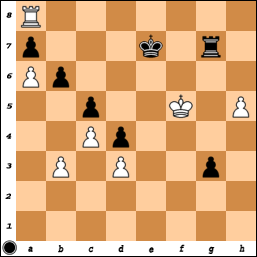
In the following position, James Morris has just played 44.Ra8 against Luke Li, who had been defending a worse position for most of the game. Here, the game continued 44...g2 45.Rxa7+ Kf8 46.Ra8+ Kf7 47.Ra7+ Kf8 with a draw, but Luke missed the stunning shot 44...Rg5+! This allows the king to hide from rook checks on d6, while also blocking the white rook's path to g1, so black will be able to promote the g pawn & have a winning (although still tricky) ending.
This was the first time I was directly involved in the tournament, although I only attended the venue (Box Hill Chess Club) on a few occasions during the event. My involvement came in the form of editing the tournament bulletins, which were produced for the players on a daily basis. The Bulletins from the tournament can be downloaded as a Zip file from 4Shared (hopefully this remains in place for a reasonable length of time - if not send me an email & I'll send the bulletins to you). Feel free to post any comments you might have about the bulletins & what can be improved in the future.
I have also uploaded a PGN file of games from the tournament.
To finish the post, I have added some photos from tournament organiser Leonid Sandler.
A relaxed start to the game between Bobby Cheng & James Morris
 German FM Arkadius Kalka

 Three winners, Bobby Cheng, Anton Smirnov & James Morris
 Anton Smirnov with the perpetual trophy

Throughout the tournament there were quite a number of well played games, although there were also the occasional blunder or inaccuracy. The two games (or game & position) I want to highlight are Arkadius Kalka's quick demolition of Eddy Levi in round 6, as well as an amazing tactic missed by Luke Li in his round 2 game against James Morris.
Arkadius 'takes the bait' against Eddy & the game is decided shortly afterwards, but not how Eddy was hoping!
In the following position, James Morris has just played 44.Ra8 against Luke Li, who had been defending a worse position for most of the game. Here, the game continued 44...g2 45.Rxa7+ Kf8 46.Ra8+ Kf7 47.Ra7+ Kf8 with a draw, but Luke missed the stunning shot 44...Rg5+! This allows the king to hide from rook checks on d6, while also blocking the white rook's path to g1, so black will be able to promote the g pawn & have a winning (although still tricky) ending.
This was the first time I was directly involved in the tournament, although I only attended the venue (Box Hill Chess Club) on a few occasions during the event. My involvement came in the form of editing the tournament bulletins, which were produced for the players on a daily basis. The Bulletins from the tournament can be downloaded as a Zip file from 4Shared (hopefully this remains in place for a reasonable length of time - if not send me an email & I'll send the bulletins to you). Feel free to post any comments you might have about the bulletins & what can be improved in the future.
I have also uploaded a PGN file of games from the tournament.
To finish the post, I have added some photos from tournament organiser Leonid Sandler.
A relaxed start to the game between Bobby Cheng & James Morris


James Morris after playing the winning Rg8+ against Eddy Levi


Saturday, 10 November 2012
Chess Victoria Primary Open Final
Friday saw the final of the Chess Victoria Primary Open Schools competition played at Box Hill Chess Club. 110 players, representing 22 schools from around Victoria participated, including many of the best primary school players in the state. The semi-finals the previous week gave some indication of the teams who would likely be fighting for first place, however with the finals being played using a team swiss format rather than an individual swiss, this was sure to favour teams that could score highly across multiple boards.
Greythorn Primary got off to a fantastic start, winning their first three matches 5-0 to lead by 3.5 points & this was to prove to be an unassailable lead throughout the day, although by the conclusion of the day, this lead was only half a point! Greythorn managed to win all seven matches throughout the day, so deserved to be the winners, although the Mount View team almost caught them by the final round, finishing with two 5-0 results in the final two rounds. Deepdene were also in contention throughout the day, but never quite caught up to Greythorn & ultimately finished third.
Outstanding performances were achieved by Enoch Fan (board 1 for Greythorn) & Hamish Jones (board 4 for Mount View), who both scored a perfect 7/7! A number of other players also scored 6/7, most of whom won board prizes (although there were a number of board 2 players who scored 6/7), which are included in the full results on ChessChat.
As with the other winners, I would like to wish the Greythorn team all the best at the Australian Schools Finals in Canberra in early December.
Full results are available on ChessChat.
Unfortunately my phone died during the event, so I only have photos from the early rounds
Top 5 boards in action
 Lower boards in action
 Plenty of teachers, parents & coaches watching the games in progress

Greythorn Primary got off to a fantastic start, winning their first three matches 5-0 to lead by 3.5 points & this was to prove to be an unassailable lead throughout the day, although by the conclusion of the day, this lead was only half a point! Greythorn managed to win all seven matches throughout the day, so deserved to be the winners, although the Mount View team almost caught them by the final round, finishing with two 5-0 results in the final two rounds. Deepdene were also in contention throughout the day, but never quite caught up to Greythorn & ultimately finished third.
Outstanding performances were achieved by Enoch Fan (board 1 for Greythorn) & Hamish Jones (board 4 for Mount View), who both scored a perfect 7/7! A number of other players also scored 6/7, most of whom won board prizes (although there were a number of board 2 players who scored 6/7), which are included in the full results on ChessChat.
As with the other winners, I would like to wish the Greythorn team all the best at the Australian Schools Finals in Canberra in early December.
Full results are available on ChessChat.
Unfortunately my phone died during the event, so I only have photos from the early rounds
Top 5 boards in action


Monday, 11 June 2012
Victorian Open Day 4
The final day of the Victorian Open was another day of close, but not quite close enough ...
I managed to beat Bill Jordan in the morning round in something of an unusual opening. My Paleface Attack (1.d4 Nf6 2.f3!?) turned into an odd line of the Blumenfeld Gambit, where I was a pawn up early, but Bill had quite a bit of pressure against my position & as it transpired, could have had me in real trouble out of the opening had he played more accurately. Instead he allowed a tactic (15.Bxh7+) that won another pawn & then decided that he had to crate complications in order to try to win. Thankfully for me, I managed to survive the complications, finding the useful attacking moves 22.Rd1+ & 23.Rh5, which were just enough for me to find a way to win, to take me to 5/6, just half a point behind the leader Karl Zelesco & tied with five others in =2nd going into the last round.
Of course that meant that my final round game was going to be a tough pairing ... and I found myself playing black against IM James Morris. Depending on how results went on other boards, a win in this game could have meant =1st for the winner (and in fact winning the game would have left me on 6/7 in a tie for =1st!). A draw would also have left me in the money, sharing 3rd place & a rating group prize, while a loss would see me finish in =5th & out of the prizemoney altogether! Unfortunately for me, it was the latter of those options that transpired & although I felt that I played a good tournament (only losing to two of the eventual three winners), the lack of reward left me with something of an empty feeling.
As for the game itself, I played a Modern Defense, which transposed into a Czech Benoni. I was fairly happy with the position I reached out of the opening, particularly with James employing rather unusual piece placements (Bh3, Qg2). I managed to play both f5 & b5 (the two standard 'breaks' for black in such a blocked position), however the tactical exchange in the centre worried me, as I was not convinced that it would turn out favourably for me. The line that James ended up playing (15.b3) was not that good for him & after some exchanges, I was more than happy with my position on move 20, as I had a number of strong potential threats (f3 with threats against the king & knight, e4 with threats down the long diagonal, as well as various queen maneuvers that could prove useful), as well as a pawn structure that restricted the mobility of the white knight on e2. Unfortunately I could not quite find the best way to play the position & could never quite get my threats to work, with James finding a number of useful defensive resources in the position. Ultimately I allowed James to push his c & d pawns, which created a variety of threats & I did not handle these well at all, particularly while I was short of time.
This was one of the few tournaments I have played this year (the others being the Australian Reserves & the Sydney International) & it shows that I can still compete with the very best players in the state (if not the country), but I seem to lack that extra bit of tactical vision, or ability to handle pressure games (or a combination of the two!) that separates a player of my strength from those 2300 & above. Hopefully I can continue to work on this & any other events that I play later in the year (I haven't really considered what other events I might play for the remainder of the year yet - I'm more focussed on my arbiting at present) can continue the rating improvement that I have managed this year.
The tournament finished in a three way tie between IM James Morris & FMs Bobby Cheng & Dusan Stojic. Congratulations to those players & all the other prizewinners!
Results are available on the Chess Victoria website.
As for me, its back to being the arbiter guy at the Victorian Championships, Victorian Reserves, Melbourne Chess Club & various junior events ... at least for the time being!
I managed to beat Bill Jordan in the morning round in something of an unusual opening. My Paleface Attack (1.d4 Nf6 2.f3!?) turned into an odd line of the Blumenfeld Gambit, where I was a pawn up early, but Bill had quite a bit of pressure against my position & as it transpired, could have had me in real trouble out of the opening had he played more accurately. Instead he allowed a tactic (15.Bxh7+) that won another pawn & then decided that he had to crate complications in order to try to win. Thankfully for me, I managed to survive the complications, finding the useful attacking moves 22.Rd1+ & 23.Rh5, which were just enough for me to find a way to win, to take me to 5/6, just half a point behind the leader Karl Zelesco & tied with five others in =2nd going into the last round.
Of course that meant that my final round game was going to be a tough pairing ... and I found myself playing black against IM James Morris. Depending on how results went on other boards, a win in this game could have meant =1st for the winner (and in fact winning the game would have left me on 6/7 in a tie for =1st!). A draw would also have left me in the money, sharing 3rd place & a rating group prize, while a loss would see me finish in =5th & out of the prizemoney altogether! Unfortunately for me, it was the latter of those options that transpired & although I felt that I played a good tournament (only losing to two of the eventual three winners), the lack of reward left me with something of an empty feeling.
As for the game itself, I played a Modern Defense, which transposed into a Czech Benoni. I was fairly happy with the position I reached out of the opening, particularly with James employing rather unusual piece placements (Bh3, Qg2). I managed to play both f5 & b5 (the two standard 'breaks' for black in such a blocked position), however the tactical exchange in the centre worried me, as I was not convinced that it would turn out favourably for me. The line that James ended up playing (15.b3) was not that good for him & after some exchanges, I was more than happy with my position on move 20, as I had a number of strong potential threats (f3 with threats against the king & knight, e4 with threats down the long diagonal, as well as various queen maneuvers that could prove useful), as well as a pawn structure that restricted the mobility of the white knight on e2. Unfortunately I could not quite find the best way to play the position & could never quite get my threats to work, with James finding a number of useful defensive resources in the position. Ultimately I allowed James to push his c & d pawns, which created a variety of threats & I did not handle these well at all, particularly while I was short of time.
This was one of the few tournaments I have played this year (the others being the Australian Reserves & the Sydney International) & it shows that I can still compete with the very best players in the state (if not the country), but I seem to lack that extra bit of tactical vision, or ability to handle pressure games (or a combination of the two!) that separates a player of my strength from those 2300 & above. Hopefully I can continue to work on this & any other events that I play later in the year (I haven't really considered what other events I might play for the remainder of the year yet - I'm more focussed on my arbiting at present) can continue the rating improvement that I have managed this year.
The tournament finished in a three way tie between IM James Morris & FMs Bobby Cheng & Dusan Stojic. Congratulations to those players & all the other prizewinners!
Results are available on the Chess Victoria website.
As for me, its back to being the arbiter guy at the Victorian Championships, Victorian Reserves, Melbourne Chess Club & various junior events ... at least for the time being!
Sunday, 10 June 2012
Victorian Open Day 3
Today I was on the receiving end of two relatively favourable pairings, as I found myself in the top half of players in my score group after both rounds today, meaning I was paired against lower rated players.
The morning round saw me playing black agianst MCC regular Felix Wyss & I employed the 'Sniper' Modern Defense. Although Felix grabbed the centre with d4, c4 & e4, I still went about playing the opening as if it was similar to the 'Broken Arrow' line I have posted videos about previously, & found myself in a good position after Felix overextended in the centre. I won a pawn with a tactic & slowly pushed my advantage, stopping any counterplay for Felix before launching a counterattack of my own. Faced with the loss of another pawn, which would leave him with a hopeless position, Felix resigned.
The afternoon round saw me paired against improving junior Jason Chew. Although I tried to steer the game towards my favourite Blackmar-Diemer Gambit, Jason declined the pawn & we found ourselves in a declined Alapin French. I quite like playing these positions as white & when Jason did not play the standard counter-attacking plan involving Qb6 & a variety of knight maneuvers on the queenside, I used my space advantage to squeeze the position, ultimately breaking through on the h-file & forcing resignation while there was material equality on the board. The big issue for Jason in this game was that he basically ran out of squares to move his pieces & I managed to keep most of the pieces on the board & this further exacerbated the problems of the space disadvantage.
There was another interesting aspect to round 5, with the top twelve boards all finishing with the result 1-0! I've only looked at the Morris-Cheng game very quickly, but it looked like a crazy game!
Now that I'm on 4/5, I find myself paired against Bill Jordan in the morning (I have white), so I expect a very tough day if I want to finish in the prizes!
Results are available on the Chess Victoria website.
The morning round saw me playing black agianst MCC regular Felix Wyss & I employed the 'Sniper' Modern Defense. Although Felix grabbed the centre with d4, c4 & e4, I still went about playing the opening as if it was similar to the 'Broken Arrow' line I have posted videos about previously, & found myself in a good position after Felix overextended in the centre. I won a pawn with a tactic & slowly pushed my advantage, stopping any counterplay for Felix before launching a counterattack of my own. Faced with the loss of another pawn, which would leave him with a hopeless position, Felix resigned.
The afternoon round saw me paired against improving junior Jason Chew. Although I tried to steer the game towards my favourite Blackmar-Diemer Gambit, Jason declined the pawn & we found ourselves in a declined Alapin French. I quite like playing these positions as white & when Jason did not play the standard counter-attacking plan involving Qb6 & a variety of knight maneuvers on the queenside, I used my space advantage to squeeze the position, ultimately breaking through on the h-file & forcing resignation while there was material equality on the board. The big issue for Jason in this game was that he basically ran out of squares to move his pieces & I managed to keep most of the pieces on the board & this further exacerbated the problems of the space disadvantage.
There was another interesting aspect to round 5, with the top twelve boards all finishing with the result 1-0! I've only looked at the Morris-Cheng game very quickly, but it looked like a crazy game!
Now that I'm on 4/5, I find myself paired against Bill Jordan in the morning (I have white), so I expect a very tough day if I want to finish in the prizes!
Results are available on the Chess Victoria website.
Saturday, 9 June 2012
Victorian Open Day 2
Day 2 went as expected for me ... a win in the morning against improving junior Jack Puccini & an afternoon loss against tournament 3rd seed Dusan Stojic. Round 4 sees me playing another MCC regular, Felix Wyss. There are now 6 players who are left on 3/3 in a field of 85 players.
My game against Jack Puccini was a Modern Defense that turned into something akin to an Accelerated Dragon with c3. Jack sacrificed a pawn in the opening & we reached a fairly unique position where there was a series of knight manoeuvres, with Jack trying to put pressure on my e6 pawn, while I was trying to defend it. Ultimately Jack managed to win back the pawn, but in doing so allowed my remaining pieces to become active and Jack resigned when I was about to win material by force.
My game against Dusan Stojic was a Paleface Attack that turned into a Modern Benoni position. Game 8 of the recent World Championship match between Anand & Gelfand was a similar opening & I used the idea Anand employed in the World Championship game, playing Ng1-e2-c3. I was very happy with my position midway through the opening, before I castled kingside. This allowed Dusan to play a Nxd5 tactic & I responded to it inaccurately. Fritz suggests that I can play 17.exd5 Nxd5 18.Nxd5 (which protects the key piece on e3) & then 19.Nb5 to guard the critical d4 square from a potential Bd4. Although this sequence is somewhat tricky to spot, I was disappointed to miss it during the game, as I would have had a decent chance to score a good result against a strong player.
Results are available on the Chess Victoria website.
Lets hope today is a good day for my chess!
My game against Jack Puccini was a Modern Defense that turned into something akin to an Accelerated Dragon with c3. Jack sacrificed a pawn in the opening & we reached a fairly unique position where there was a series of knight manoeuvres, with Jack trying to put pressure on my e6 pawn, while I was trying to defend it. Ultimately Jack managed to win back the pawn, but in doing so allowed my remaining pieces to become active and Jack resigned when I was about to win material by force.
My game against Dusan Stojic was a Paleface Attack that turned into a Modern Benoni position. Game 8 of the recent World Championship match between Anand & Gelfand was a similar opening & I used the idea Anand employed in the World Championship game, playing Ng1-e2-c3. I was very happy with my position midway through the opening, before I castled kingside. This allowed Dusan to play a Nxd5 tactic & I responded to it inaccurately. Fritz suggests that I can play 17.exd5 Nxd5 18.Nxd5 (which protects the key piece on e3) & then 19.Nb5 to guard the critical d4 square from a potential Bd4. Although this sequence is somewhat tricky to spot, I was disappointed to miss it during the game, as I would have had a decent chance to score a good result against a strong player.
Results are available on the Chess Victoria website.
Lets hope today is a good day for my chess!
Friday, 8 June 2012
Victorian Open Day 1
Its a long weekend ... I've been spending the last few weeks doing quite a bit of chess coaching and arbiting a number of chess tournaments ... so as a 'break' from all these things, I decided to actually PLAY a chess tournament ... namely the Victorian Open, held at the Box Hill Chess Club.
The tournament is a 7 round event with time controls of 90 minutes + 30 seconds per move (the current standard time control for most FIDE rated events in Australia) & started with a round on Friday night, with later rounds at 10am (yes, horribly early for a chess tournament!) & 3pm on Saturday, Sunday & the public holiday Monday. There are around 80 players in the event (a few took byes in round 1, so I won't know the final field size until tomorrow), while I also don't really know where I am seeded at the moment. As happens with a tournament of this size, there is occasionally an administrative oversight (I know how easy it is to do from experience, having made a few in my relatively short time as an arbiter), and this meant that I was left out of the round 1 pairings. As it turned out, there were three other players who were in a similar situation, so that made for two pairings of 'leftover' players. This meant that I ended up playing Michael Placentino, who has an ACF rating of 1585 (I think if I was in my proper seeding position of around 10-15 I would have had an opponent around 1400 in rating). Luckily for me, Michael played very passively in the opening & found himself in trouble early & played a few errant moves, which almost gifted me the point. Having said that, I was a little disappointed not to have spotted the forced mate that the computer said I had with 17.Rh7+ (I had examined the move, but couldn't see the follow-up), missing the idea of Qh2, with unstoppable threats on the h-file.
Lets hope I can keep adding to the W column tomorrow!
I would expect the results to eventually be posted on ChessChat, although they have not been posted yet.
The tournament is a 7 round event with time controls of 90 minutes + 30 seconds per move (the current standard time control for most FIDE rated events in Australia) & started with a round on Friday night, with later rounds at 10am (yes, horribly early for a chess tournament!) & 3pm on Saturday, Sunday & the public holiday Monday. There are around 80 players in the event (a few took byes in round 1, so I won't know the final field size until tomorrow), while I also don't really know where I am seeded at the moment. As happens with a tournament of this size, there is occasionally an administrative oversight (I know how easy it is to do from experience, having made a few in my relatively short time as an arbiter), and this meant that I was left out of the round 1 pairings. As it turned out, there were three other players who were in a similar situation, so that made for two pairings of 'leftover' players. This meant that I ended up playing Michael Placentino, who has an ACF rating of 1585 (I think if I was in my proper seeding position of around 10-15 I would have had an opponent around 1400 in rating). Luckily for me, Michael played very passively in the opening & found himself in trouble early & played a few errant moves, which almost gifted me the point. Having said that, I was a little disappointed not to have spotted the forced mate that the computer said I had with 17.Rh7+ (I had examined the move, but couldn't see the follow-up), missing the idea of Qh2, with unstoppable threats on the h-file.
Lets hope I can keep adding to the W column tomorrow!
I would expect the results to eventually be posted on ChessChat, although they have not been posted yet.
Subscribe to:
Posts (Atom)