Showing posts with label checkmate. Show all posts

Tuesday, 14 May 2013

Northern Star Chess Squad - May 5

Term 2 of the Northern Star Chess Squad started with a small but enthusiastic group of new faces to the group! The day started after a slight hiccup when I left my keys at home, so there was a slight delay while the keys arrived! Once underway, the group started with a look at Grandmaster Zong-Yuan Zhao, who is currently Australia's number 1 player. The thing for me that stands out about Zong-Yuan's play is his understanding of the positional side of chess, particularly in terms of compensation when there is a material imbalance. As a strong Grandmaster, he is able to play both tactically & strategically, although I suspect he tends to mostly favour strategic play when playing in Australia, as that is where he generally has the biggest advantage over his opposition.
The group looked at a recent game of Zong-Yuan's that highlighted this strength, with his game against former world title contender Nigel Short, from the Bankok Chess Club Open (which Zong-Yuan won against a tough field which featured over 20 GMs & more than 50 titled players!). After a quiet opening, Short launches a king-side attack, which Zong-Yuan responds to in a thematic way, counter-attacking in the centre. Zong-Yuan then goes on to sacrifice three pawn to ensure Short's king stays in the centre & his pieces remain tied down in the early middle game. Zong-Yuan then embarked on a number of favourable exchanges left him with a queen for two minor pieces & two pawns in an ending, which he was able to convert into a win.


After looking at the game, the students then played games, which will be analysed for next week's session.

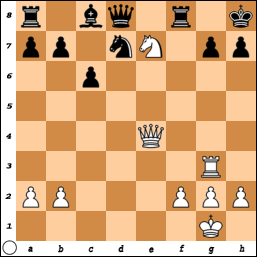
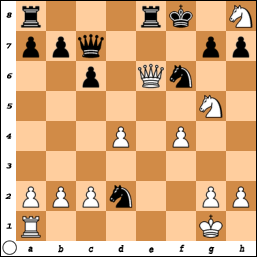
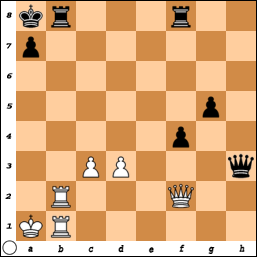
The final session for the day looked at a variety of checkmating patterns, with the students attempting to find the checkmate in a variety of different positions. Many of these had a number of checkmating themes, which made move order critical in terms of successfully achieving checkmate!


In the above position, the checkmating pattern is an 'electric fence' rook checkmate, which comes about by playing 1.Qxa7+ Kxa7 2.Ra2#


In this example the theme is a variation on back rank mate, which comes about on the side of the board on this occasion after 1.Qxh7+ Kxh7 2.Rh3#


In this example the theme is removal of the defender, with checkmate coming about after 1.Nxh7+ Nxh7 2.Ng6#

The squad is a great learning environment for kids, as they are able to learn with others who share their passion & interest in chess. The small group sessions are generally more cost-effective than private coaching & the content and format offered is unique to Northern Star. If you are interested in having your child attend, please contact Pearl Yung at Northern Star Chess, or look on the squad webpage for more information.

Tuesday, 19 March 2013

Northern Star Chess Squad - Day 4

The final Northern Star Chess Sunday squad session for the term was another enjoyable day at Eltham High.
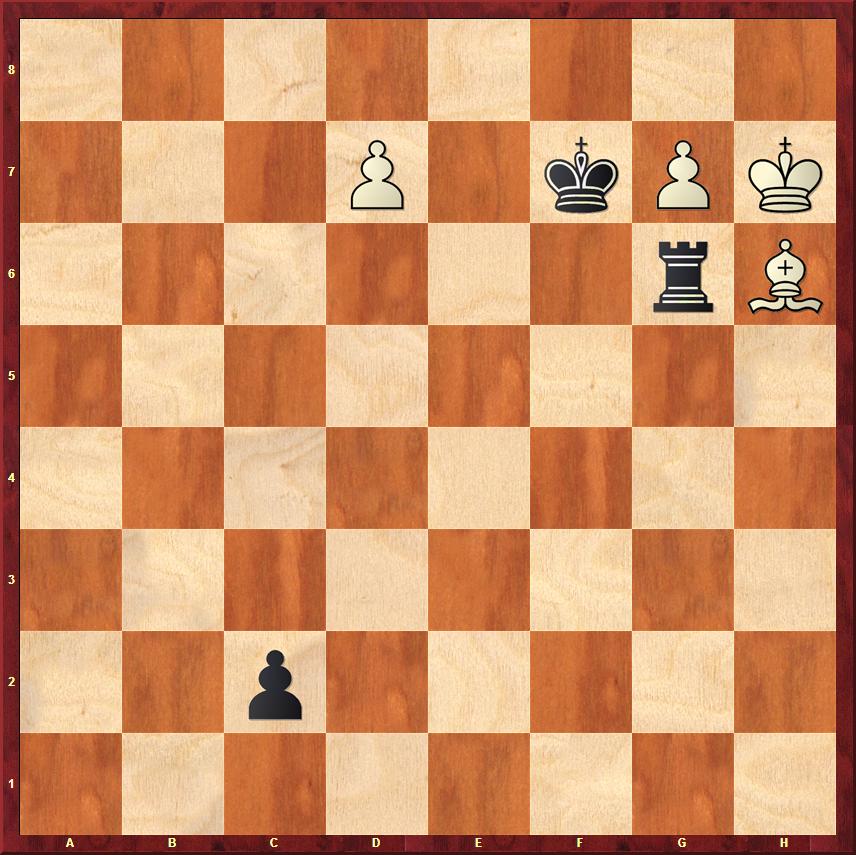
This week we started with another puzzle, which took a while for the kids to figure out as the solution is somewhat counter-intuitive.
The importance in this position is to make forcing moves, as any non-forcing move allows black to play Rxh6+ followed by c1=Q+, which allows black to get at least a draw, if not more.
The solution is 1.d8=N+ Kf6 2.g8=N+, with a technical win after 2...Rxg8 3.Kxg8 (albeit requiring knowledge of how to checkmate with bishop, knight & king against a lone king), while 2...Kf5 allows 3.Ne7+ followed by capturing the rook, with another technically winning endgame (albeit a little easier with the extra knight).
I also explained to the students how rare such an ending is in tournament chess - I have been playing tournaments for around 20 years & have only had this ending occur once (and that was only last year in the Sydney International)!
For the sake of completeness, here is the game in question, which I played against Emma Guo.


This week's board, with the outline for the day, as well as the final position (actually a few moves after the final position) in the game Georgiev-Rogers, which is one of the best finishes to a game by Australian GM Ian Rogers, who was the 'feature player' of the day.
Ian Rogers was the first Australian born & raised player to become a Grandmaster (Walter Browne was one example of an Australian-born player who became a Grandmaster, but he moved to America at a young age, although he did represent Australia at two Olympiads in the early 1970s). Ian's style was described in similar terms by Doug Hamilton & Guy West in Australian Chess at the Top as a very pragmatic, tactical style. Ian's opening preparation & knowledge, particularly in obscure openings, was also described as particularly strong & I know from experience that Ian can definitely finish an opponent off quickly if they go wrong in the opening.
The first game we looked at was a Rogers' brilliancy from the 1992 Chess Olympiad, against Brazilian GM Gilberto Milos, which highlighted Ian's tactical ability, with both the piece sacrifice 26.Bxc6+ & the final combination beginning with 31.Rdc3 being excellent examples of Rogers in full flight!


The group also looked at the finish to the game Georgiev-Rogers from the Biel Interzonal of 1993, which was another example of a sparkling tactical finish!
Below is the game in its entirety


After looking at these games of Rogers, the group played games which I will analyse later, although from a quick look at some of them, all players need to work on their defensive side of their games!
The final session of the day looked at another example of bishops v knights, this time form the game O'Kelly-Najdorf from the 1950 Chess Olympiad, starting from the following position:
Believe it or not, this position is all about bishops v knights, with the critical pieces being the black knight on c5 & the white bishop on g2, with the resulting position being advantageous to black, as the g2 bishop is hemmed in by its own pawns, while the knight's movement is not restricted in any way. The finish of the game is a very good demonstration of the power of a good knight & the problem of a bad bishop.


I finished off the session with some checkmating patterns, with a somewhat self-indulgent method of looking at checkmates from my own games, with the conclusion to three games being shown to the group.
The first position is from a 2010 game against Ari Dale, where I managed to win as white in the above position, although my method was not the most economical.
The game finished 38. Bd4+ Ka6 39. Qc5 c3+ 40. Kxc3 Qc6 41. b5+ & Ari resigned when faced with various unstoppable checkmate threats (41... Qxb5 42.Qa6# or 41... Ka5 42. bxc6+ Ka4 43. Qb4# or 41... Ka5 42. bxc6+ Ka6 43. Qb6#)
However if I play things in a different move order, the finish is quicker: 38. Bd4+ Ka6 39. b5+! with the following options:
39... Ka5 40. Qb4#
39... Kxb5 40. Qc5+ Ka4 41. Qb4#
39... Kxb5 40. Qc5+ Ka6 41. Qb6#
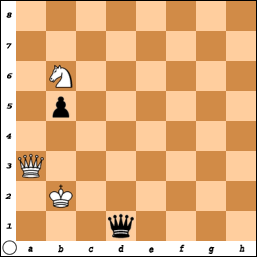
The second position is from a 2011 game against Kevin Brown, where I won as black with a nice tactic to finish the game (although I am already doing well in the position).
The game ended with Kevin resigning after 39... Rd1, which is a nice deflection tactic, as the queen on c1 is tied to the defense of the b2 square. The kids needed to find not only the winning move, but the variations to checkmate, which run as follows:
40. Qxd1 Qb2#
40. Qa3 Ra1+ 41. Kxa1 Qxa3+ 42. Kb1 Qb2#
40. Qb1 Qa4#
40. Qa1 Qa4#
Any other move allows an eventual Qb2#
The final position is from a 2012 game of mine where I was white against Gavin Marner. It is also one of the many checkmate problems in Gary Lane's recently published book Gary Lane's Chess Puzzles.
The game ended with the spectacular 32. Qxh7+ Kxh7 33. Rh1+ Kg7 34. Bh6+ Kf6 35. Ng8#
The alternative defensive option 34... Kh8 provides no relief for the king due to 35. Bf8#
The difficulty with this position is that if white doesn't find a way to win, black has a number of threats to go with the extra two pawns in the position, so accurate calculation & self-belief are needed to find a way to win the game.

The squad will be running again on Sundays in term 2 starting on May 5, so please contact Pearl Yung at Northern Star Chess or look on the Squad webpage for more details.
Tuesday, 5 March 2013

Northern Star Chess Squad - Day 3

Another Sunday saw another fun session with the Northern Star Chess Squad at Eltham High! Now that we have some 'regulars', the group is able to get through even more material ... and some fascinating chess!
This week we started with the solution to last week's mystery puzzle ... White has a Queen, Knight & King against Black's King & all you know about the position is that white plays Nc6-d8#. The challenge is to correctly locate all the pieces on the board to make this a reality.
The correct solution has a white queen on g5, knight on c6 (obviously) & king on c7, while the black king is on e6, so Nd8# is possible. The important aspect that stands out with this puzzle is that all the white pieces are helping control at least 2 squares that the black king could potentially escape to, yet there is no 'doubling up', with each square around the black king defended only once, making for the most economical use of pieces!
This week's board, with the daily outline & the first position from the Creating Checkmates section. The group were enthralled by Shirov's games, so we didn't have time to look at another bishops v knights position that I had hoped to look at ... though it will most likely fit into the final session for the term (in a fortnight as next weekend is a long weekend). 
After the puzzle, we looked at Spanish (formerly Latvian) Grandmaster Alexei Shirov, who plays a fascinating attacking style of chess that I love to watch! Shirov's love of complicated positions, particularly from the Botvinnik Semi-Slav, make for exciting chess, although playing such 'knife edge' chess does have its risks & this is one of the reasons Shirov has not been able to stay in the upper echelon of players in the world for an extended period of time (although in recent times he has been a fixture in the top 50, I'm talking about being in the top 3 or 4 players in the world).
The first game we looked at was a fascinating game between Vladimir Kramnik & Shirov, where Shirov appeared to be in trouble for much of the game. However it is a great example of Shirov's fighting ability & willingness to play chess on the edge of disaster, with the amazing 31...Re4!! being a fantastic move which turns the tables on Kramnik & is the start of the end after Kramnik goes astray.


The group were amazed by the way Shirov played the end of this game & were move shocked when I showed them the famous finish his game against Topalov from Linares 1998, which has been called the Greatest Move of All Time by John Emms, as well as a number of others.
Here is the game in its entirety - not the most interesting game, but the finish is definitely something to see!


After looking at Shirov, the students played some games, which I will examine later in the week.
To conclude the group for this week, we looked at constructing checkmating positions with pieces, where the pieces were set up without the black king & the students had to locate the correct square (or squares) where the black king could be placed so that the position was checkmate.
Here is an example of the type of positions we looked at:

The next (and final session for the term) is in two weeks time & hopefully the group will continue to grow, particularly with a big term 2 planned!

If anyone reading this is interested in attending the squad sessions, contact Pearl Yung at Northern Star Chess, or look at the Squad Page for more information.

Friday, 13 April 2012

Sydney International Open Day 3

I started day three in horrible fashion, losing to New Zealand junior Luke Li on the white side of an e6 Trompowsky in a relatively quick game. The e6 line is something I have had difficulty playing against in recent years, particularly when my opponents choose to play in a similar manner to a French Defense, as Luke did in our round 5 clash. This time I had the weakness on d4 sufficiently protected, but it was my queenside pawns that collapsed before allowing Luke to invade with his rooks.
In the second game of the day I played Women's International Master Emma Guo from Canberra. After a difficult opening (I always find it tricky to get the right move order early on in the Philidor's), I managed to find myself in a playable position when I thought I could win a piece with 14...Qa5, only to find out that winning the piece would leave my queen trapped. Although retreating would be a reasonable option, I decided to see what I could get for the queen & realised I was able to end up taking a rook, bishop, knight & pawn for my queen & knight, so decided to go ahead with things & play a position with an unusual material imbalance. After a few exchanges, Emma decided to grab my a-pawn with her queen, which allowed me to use my remaining rook, bishop & knight to generate mating threats against her king. Ultimately Emma decided to return the queen for a rook to stop the checkmate, leaving me with bishop, knight & 4 pawns against Emma's knight & 5 pawns. Emma fought on trying to draw the position, in once instance trying to leave me (after some pawn exchanges) with a potential bishop & wrong-coloured rook pawn ending, but I avoided this & calculated that although Emma could take my last remaining pawn, I would trap her knight. This left me with a task that I don't think I have ever had to do in a tournament game - checkmating with bishop, knight & king against a lone king! Once I had taken Emmas's knight, she still had an a & h pawn remaining, so I decided that I would leave her h-pawn on the board (making sure to have the promotion square defended by my bishop) & improve the position of my other pieces before capturing the final pawn. This would allow me to have more room for stuff-ups while trying to checkmate before the 50 move rule draw kicked in. Although initially I was a little rusty, I managed to checkmate reasonably efficiently ... in spite of not using the 'W' method that I had remembered was one of the techniques for winning the position.


Today I start with yet another tough morning pairing - black against Jason Hu! Somehow I don't remember things being this tough when I played in the SIO a few years ago! Let's hope I can score another point at least today!