Showing posts with label Ian Rogers. Show all posts

Saturday, 1 November 2014

Hjorth Open - Day 2

Day two of the Hjorth Open saw seven players finish the day on a perfect 3/3, and these were unsurprisingly seven of the top 8 seeds (third seed James Morris took a half point bye in round 1, but was leading the chasing pack on 2.5/3).

The second day saw more upset results than the first, with Jody Middleton & Richard Voon beating higher rated opponents in round 2, while Richard Voon also scored another upset win in round 3. There were also a few draws across the day, while some of the unrated players (young & old) scored wins against their rated opponents.

One of the more exciting games from day two was from round 3, which saw a wild battle between FIDE Masters, with Domagoj Dragicevic's King's Gambit turning sour fairly quickly against Luke Li.


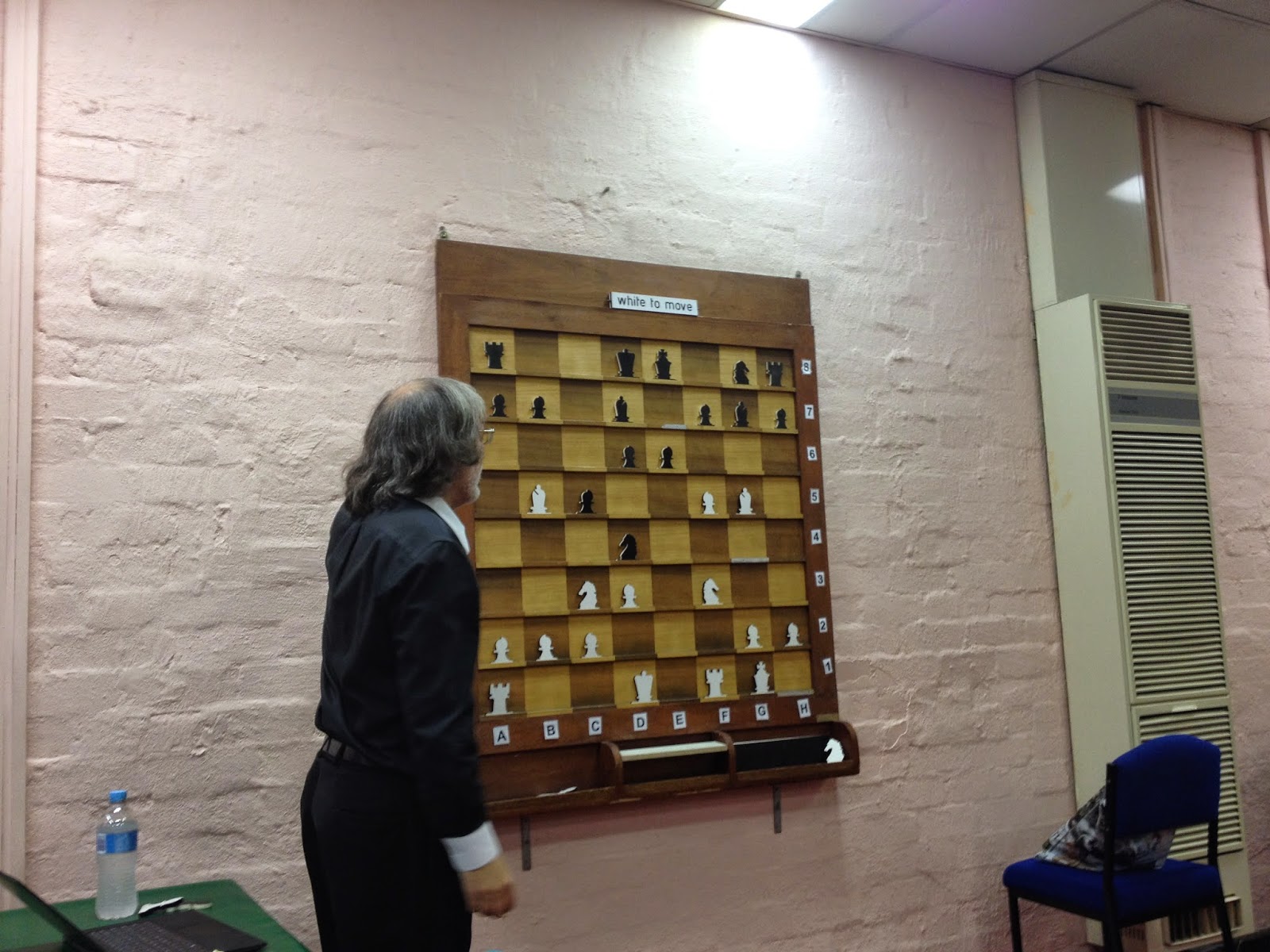
However the highlight of the day was the lecture presented by Grandmaster Ian Rogers about Greg Hjorth. Ian told stories of Greg's time in the chess scene & showed a number of games or game fragments played by Greg, including wins over former Australian Champion Serge Rubinraut & American Grandmaster Robert Byrne. He also showed Greg's impressive analytical ability in an adjourned position from one of Darryl Johansen's games from the 1982 Olympiad (where Greg was the second reserve & did not play the game, but played a key role as an analyst for the other team members).

GM Ian Rogers talking about Greg's early years in chess
GM Ian Rogers analysing Greg Hjorth's win over former Australian Champion Serge Rubinraut
An adjourned endgame position of Darryl Johansen's from the 1982 Olympiad, where Greg's analysis proved instrumental in Darryl's eventual victory
GM Ian Rogers explaining how Greg Hjorth was able to hold the following position against Filipino GM Eugene Torre, with the key idea being to check the white king if it tries to move in front of the pawn, while the king (in spite of being cut off from getting in front of the pawn) prevents the rook from protecting the pawn from the side.
GM Ian Rogers explaining one of Greg's often-used sidelines against the Sicilian Defence - 2. b3, which was almost unheard of in the late 1970s & early 1980s when Greg was playing.

Sunday, 10 August 2014

The Olympiad Trip - Day 14

Today I returned to board 18 for the clash between Vietnam & Iran. Apart from board 1, the other boards were fairly closely matched on rating, so it promised to be an exciting match. All four games turned out to be decisive, with Vietnam winning the match 3-1, with the games on board 1 & 4 standing out for Game of the Round. On board 1 Quang Le managed to turn a fairly even looking queen & rook endgame to his advantage with a surprisingly effective attack on the king, while Huynh Nguyen played a Hedgehog Sicilian & once he managed to open the game up with d5, found a variety of tactical shots to ensure he grabbed the initiative & maintained it until the end of the game.

 The matchups for board 18 today
Some technical issues with the DGT board sorted out before the players arrive
Board all ready for the players
Players ready to start play
 
Quang Le generates strong threats against the king from a fairly innocuous position to bring home the point on board 1


Huynh Nguyen manages to unleash the potential of the Hedgehog in a nice tactical display


Also today with Australia's open team doing so well, they were playing on board 16, directly next to me, so I had a birds-eye view of  their clash with Uzbekistan. Although they ended up losing the match 3-1 (Moulthun & Max both drew, while David & Junta lost), they definitely had their chances & at different points may have been better on all three lower boards.

 The tough assignment for the Australian team today
The team is ready to go as the Uzbeki's arrive at the board
Fighting on late into the round, with team captain watching the games intently

Did you know ... Ukrainian GM Vassily Ivanchuk does things a little differently ... well if there was any doubt, he confirmed these suspicions during yesterday's match with Kazakhstan. Not once, but twice during the match he decided that he needed to wash his hands in the middle of the playing hall, so grabbed a bottle of water from his table, splashed water over his hands & proceeded to wash them in the playing hall in between the match tables. To make matters worse, he was rather liberal with his use of water, so there was a small puddle on the floor immediately after 'Chucky' had finished his cleaning routine! I was the arbiter for the adjacent match & when I saw this, simply looked at the arbiter for the match & we both shook our heads ... things definitely are done differently on Planet Ivanchuk!

I also discovered that in spite of the measures for keeping spectators away from games, there are still times when crowds gather around exciting games ...
Here Grischuk has quite a crowd gathered to see the conclusion of his game (it ended in a draw, so the match between Russia & Spain finished tied at 2-2)

I had a request for a photo of the Lebanese women's team ... but this is currently the best I can do - board 2, WFM Elena Nekrasova in action late in the round against South Africa.
I also noticed this spirited debate between Australian Women's coach GM Ian Rogers & an arbiter after the conclusion of Australia's match with Serbia (Serbia won 3-1). Although I am not sure of the exact details, it seems they were talking about the role of the Captain in the match & things the Captain is & is not allowed to do. I'll try to find out more about this in the coming days, but don't have anything to add at this stage.

Saturday, 10 August 2013

Books at Melbourne Chess Club

Recently the Melbourne Chess Club received a donation of a large number of chess books from the estate of Ray Johnstone, who was quite the collector of chess books! I found a brief profile of him as well as a copy of an obituary online & the chess books in his collection recently found their way to MCC. Ray seems like he was quite an original thinker, who was prepared to back up his ideas in practice, such as taking up smoking in response to a number of scientific papers against smoking which he thought contained significant errors! He was also by all accounts a strong attacking chess player, coming close to winning the Western Australian title on a number of occasions. As there were so many books, MCC offered a number of them for a gold coin donation, with the particularly rare or modern volumes going to the bookshop for sale at a later date.
The picture above shows the books I picked up ... quite the collection! 
I managed to find quite a number of books of interest, in particular Adriaan de Groot's Thought and Choice in Chess, which in one of the first books that covers thinking patterns in chess, which is something I am interested in & have blogged about in the past. I also found a number of books about local chess & personalities which I picked up, including biographies of CG Watson & WA Whyatt, books on the 1975 Zonal & Australian Open, Ian Rogers' famous Australian Chess into the Eighties about the 1980 Australian Championship & even a short book on the King's Gambit written by Aussie Trevor Hay!
I'm not sure that I'll ever get around to reading all of them, but they will definitely be well looked after as part of my ever-expanding chess library!

Tuesday, 19 March 2013

Northern Star Chess Squad - Day 4

The final Northern Star Chess Sunday squad session for the term was another enjoyable day at Eltham High.
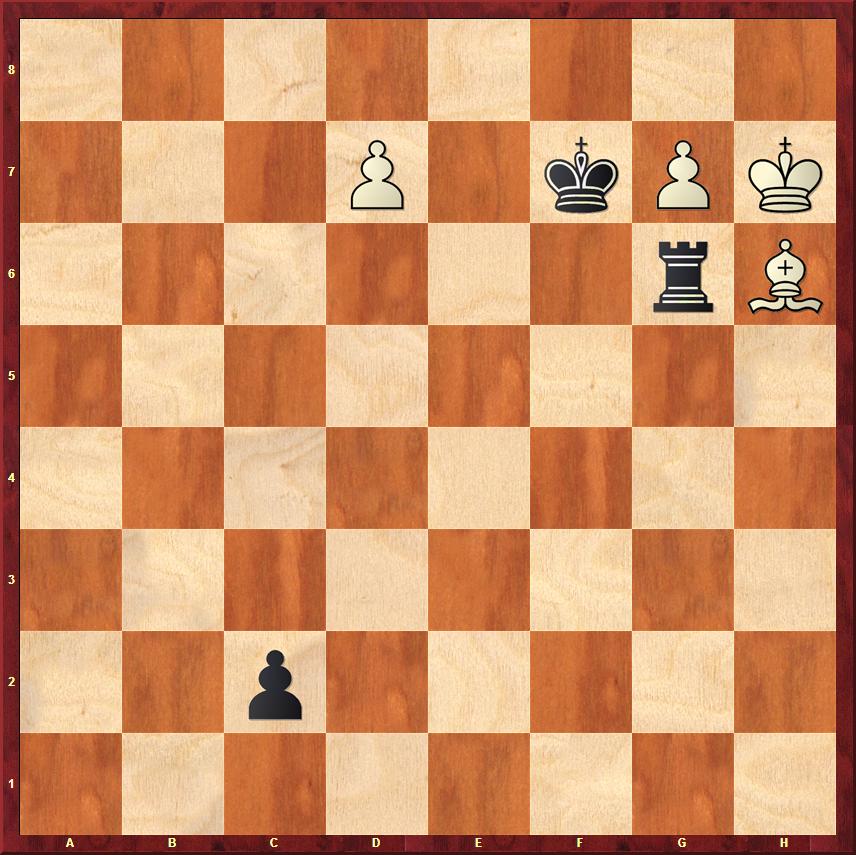
This week we started with another puzzle, which took a while for the kids to figure out as the solution is somewhat counter-intuitive.
The importance in this position is to make forcing moves, as any non-forcing move allows black to play Rxh6+ followed by c1=Q+, which allows black to get at least a draw, if not more.
The solution is 1.d8=N+ Kf6 2.g8=N+, with a technical win after 2...Rxg8 3.Kxg8 (albeit requiring knowledge of how to checkmate with bishop, knight & king against a lone king), while 2...Kf5 allows 3.Ne7+ followed by capturing the rook, with another technically winning endgame (albeit a little easier with the extra knight).
I also explained to the students how rare such an ending is in tournament chess - I have been playing tournaments for around 20 years & have only had this ending occur once (and that was only last year in the Sydney International)!
For the sake of completeness, here is the game in question, which I played against Emma Guo.


This week's board, with the outline for the day, as well as the final position (actually a few moves after the final position) in the game Georgiev-Rogers, which is one of the best finishes to a game by Australian GM Ian Rogers, who was the 'feature player' of the day.
Ian Rogers was the first Australian born & raised player to become a Grandmaster (Walter Browne was one example of an Australian-born player who became a Grandmaster, but he moved to America at a young age, although he did represent Australia at two Olympiads in the early 1970s). Ian's style was described in similar terms by Doug Hamilton & Guy West in Australian Chess at the Top as a very pragmatic, tactical style. Ian's opening preparation & knowledge, particularly in obscure openings, was also described as particularly strong & I know from experience that Ian can definitely finish an opponent off quickly if they go wrong in the opening.
The first game we looked at was a Rogers' brilliancy from the 1992 Chess Olympiad, against Brazilian GM Gilberto Milos, which highlighted Ian's tactical ability, with both the piece sacrifice 26.Bxc6+ & the final combination beginning with 31.Rdc3 being excellent examples of Rogers in full flight!


The group also looked at the finish to the game Georgiev-Rogers from the Biel Interzonal of 1993, which was another example of a sparkling tactical finish!
Below is the game in its entirety


After looking at these games of Rogers, the group played games which I will analyse later, although from a quick look at some of them, all players need to work on their defensive side of their games!
The final session of the day looked at another example of bishops v knights, this time form the game O'Kelly-Najdorf from the 1950 Chess Olympiad, starting from the following position:
Believe it or not, this position is all about bishops v knights, with the critical pieces being the black knight on c5 & the white bishop on g2, with the resulting position being advantageous to black, as the g2 bishop is hemmed in by its own pawns, while the knight's movement is not restricted in any way. The finish of the game is a very good demonstration of the power of a good knight & the problem of a bad bishop.


I finished off the session with some checkmating patterns, with a somewhat self-indulgent method of looking at checkmates from my own games, with the conclusion to three games being shown to the group.
The first position is from a 2010 game against Ari Dale, where I managed to win as white in the above position, although my method was not the most economical.
The game finished 38. Bd4+ Ka6 39. Qc5 c3+ 40. Kxc3 Qc6 41. b5+ & Ari resigned when faced with various unstoppable checkmate threats (41... Qxb5 42.Qa6# or 41... Ka5 42. bxc6+ Ka4 43. Qb4# or 41... Ka5 42. bxc6+ Ka6 43. Qb6#)
However if I play things in a different move order, the finish is quicker: 38. Bd4+ Ka6 39. b5+! with the following options:
39... Ka5 40. Qb4#
39... Kxb5 40. Qc5+ Ka4 41. Qb4#
39... Kxb5 40. Qc5+ Ka6 41. Qb6#
The second position is from a 2011 game against Kevin Brown, where I won as black with a nice tactic to finish the game (although I am already doing well in the position).
The game ended with Kevin resigning after 39... Rd1, which is a nice deflection tactic, as the queen on c1 is tied to the defense of the b2 square. The kids needed to find not only the winning move, but the variations to checkmate, which run as follows:
40. Qxd1 Qb2#
40. Qa3 Ra1+ 41. Kxa1 Qxa3+ 42. Kb1 Qb2#
40. Qb1 Qa4#
40. Qa1 Qa4#
Any other move allows an eventual Qb2#
The final position is from a 2012 game of mine where I was white against Gavin Marner. It is also one of the many checkmate problems in Gary Lane's recently published book Gary Lane's Chess Puzzles.
The game ended with the spectacular 32. Qxh7+ Kxh7 33. Rh1+ Kg7 34. Bh6+ Kf6 35. Ng8#
The alternative defensive option 34... Kh8 provides no relief for the king due to 35. Bf8#
The difficulty with this position is that if white doesn't find a way to win, black has a number of threats to go with the extra two pawns in the position, so accurate calculation & self-belief are needed to find a way to win the game.

The squad will be running again on Sundays in term 2 starting on May 5, so please contact Pearl Yung at Northern Star Chess or look on the Squad webpage for more details.